
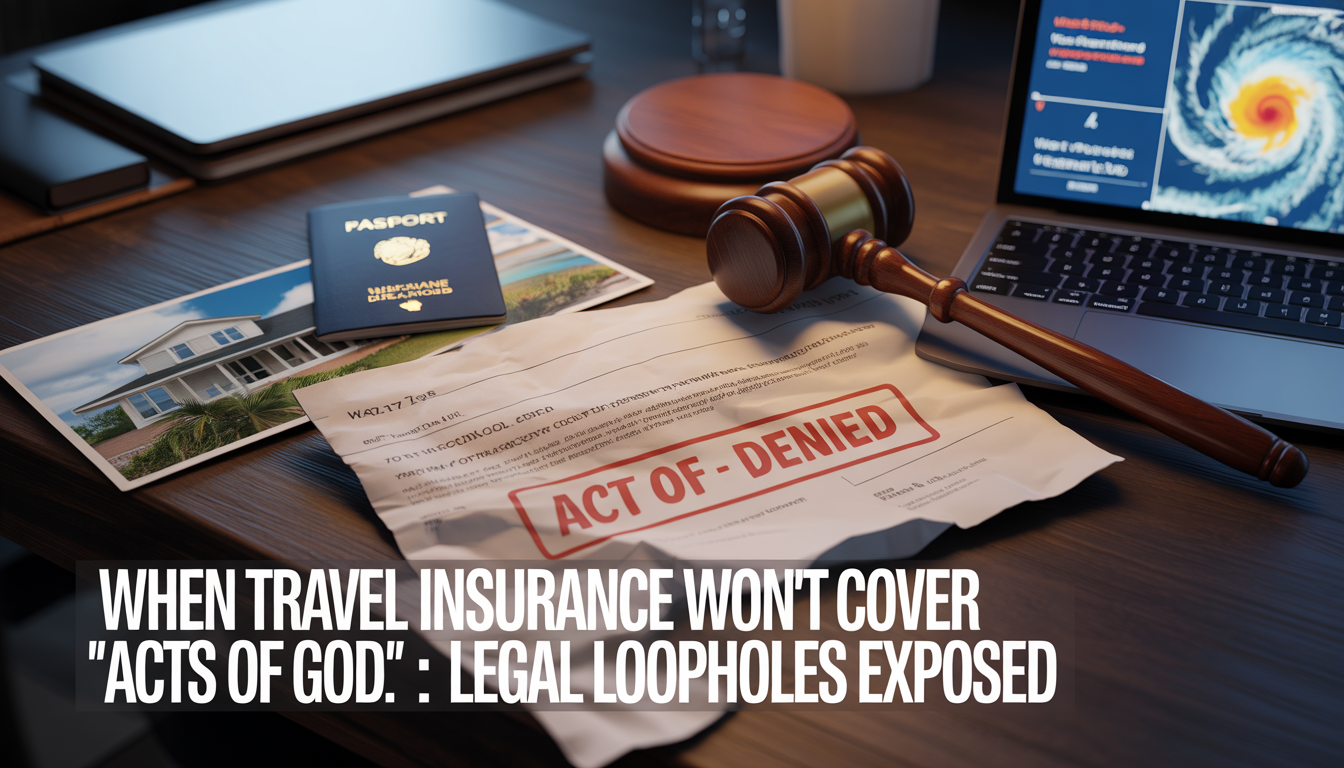
The phone call came at 6:14 AM. I was jolted awake by the frantic voice of my sister on the other end of the line.
“It’s gone. Everything is gone.”
She was sobbing. She and her husband had been vacationing in a coastal town when a sudden, violent storm swept through overnight. They had evacuated to a friend’s house inland, but their rental villa—perched on a cliff overlooking the ocean—had taken a direct hit. A massive tree had crashed through the roof. The winds had shredded the outdoor furniture. Floodwater had destroyed their luggage, their electronics, their passports, and the rental car parked outside.
I remember telling her, “It’s okay. You bought travel insurance, right?”
She had. She bought the premium plan. The one with “trip cancellation,” “trip interruption,” and “emergency medical.” She was covered. Or so we thought.
Three weeks later, the denial arrived.
The email was polite, professional, and devastating. It cited a single exclusion buried deep in the policy document:
“We do not cover loss or damage caused by or resulting from Acts of God, including but not limited to earthquakes, hurricanes, floods, tornadoes, and other natural disasters.”
Acts of God. A 17th-century legal term was being used to deny my sister’s claim for a storm that was broadcast on international news. The insurance company acknowledged the storm happened. They acknowledged my sister had coverage. But they argued that because the storm was a “natural disaster” and not a “man-made event,” they owed her nothing.
She lost $8,700 in property, accommodations, and expenses. The insurance company paid $0.
This is the dirty secret of the travel insurance industry. They sell you peace of mind, but they fill their policies with exclusions so broad that they can deny coverage for the very events you are most afraid of. And “Acts of God” is the most abused exclusion in the entire industry.
Over the next several thousand words, I am going to expose exactly how travel insurance companies use the “Act of God” loophole to deny claims, the specific legal strategies you can use to fight back, and—most importantly—how to read a policy so you never get caught in this trap.
The History of “Act of God” and Why It Still Exists
The term “Act of God” has its roots in English common law from the 16th century. It was originally used to describe events that were so extraordinary and unpredictable that no human could have foreseen or prevented them—things like lightning strikes, earthquakes, and sudden floods.
In contract law, an “Act of God” was a defense. If a party promised to do something but was prevented by an Act of God, they could avoid liability because the event was beyond human control.
Fast forward to the 21st century. We have satellite imagery, weather forecasting, climate modeling, and real-time storm tracking. We can predict hurricanes days in advance. We can issue evacuation orders. We can prepare.
Yet insurance companies still use this archaic term. Why? Because it works. It gives them a blanket excuse to deny claims for the most common travel disruptions: hurricanes, blizzards, wildfires, floods, and volcanic eruptions.
When you buy travel insurance, you think you are buying protection against the unexpected. The insurance company interprets that as protection against everything except the unexpected—because if the event was “unforeseeable,” they call it an Act of God and deny your claim.
How the “Act of God” Exclusion Is Written
The “Act of God” exclusion rarely appears in bold letters at the top of the policy. It is buried. It is disguised. And it is often combined with other exclusions to create a wall of denial.
Here are three common ways insurers word this exclusion:
Version 1: Direct Exclusion
“We do not cover any loss or damage caused directly or indirectly by Acts of God, including but not limited to earthquakes, floods, hurricanes, tornadoes, volcanic eruptions, and other natural disasters.”
This version is the most aggressive. It excludes coverage for natural disasters entirely. If a hurricane cancels your flight, you are not covered. If a flood destroys your rental property, you are not covered. If a wildfire forces you to evacuate, you are not covered.
Version 2: “Weather” Exclusion with a Loophole
*”We cover weather-related cancellations only if the weather causes complete cessation of services by the common carrier for at least 24 consecutive hours. We do not cover weather events that are considered foreseeable or predicted.”*
This version is sneaky. It pretends to cover weather, but it adds impossible conditions. If a hurricane is forecasted, the airline will cancel flights before the 24-hour mark to keep passengers safe. Because the cancellation happened before the 24-hour threshold, the insurer denies the claim. They also argue that because the storm was “predicted,” it was foreseeable and therefore excluded.
Version 3: Force Majeure Language
“We do not cover losses arising from force majeure events, including acts of God, war, terrorism, civil unrest, or government actions.”
This version lumps natural disasters with war and terrorism. It is designed to make you think the exclusion only applies to extreme, rare events. But in practice, insurers use it to deny claims for anything from a thunderstorm to a minor earthquake.
My Sister’s Case: How the Loophole Worked
Let me walk you through exactly how my sister’s claim was denied. Understanding this process is essential if you want to fight your own denial.
The Policy
My sister purchased a “Comprehensive Travel Protection” plan from a well-known travel insurance company. The premium was $347 for a two-week trip. The policy included:
- Trip cancellation: up to $10,000
- Trip interruption: up to $10,000
- Baggage loss: up to $2,500
- Emergency medical: $100,000
The Event
A sudden, violent storm struck the coastal region where she was staying. It was not a named hurricane. It was not predicted by local weather forecasts until 12 hours before landfall. Winds exceeded 80 miles per hour. A tree fell through the roof of her rental villa. Floodwater destroyed her belongings.
The Denial
The adjuster cited Section 12, Paragraph 4 of the policy:
“This policy does not cover any loss caused by or resulting from Acts of God, including natural disasters, storms, floods, and weather events of any kind.”
When my sister called to appeal, the representative explained: “Because the loss was caused by a storm, and storms are classified as Acts of God, there is no coverage under the policy.”
My sister asked: “Then what does the policy cover?”
The representative paused. “The policy covers events like theft, fire, and medical emergencies.”
In other words, they sold her a policy that specifically excluded the most likely reason she would need to make a claim in a coastal region during storm season.
The Legal Reality: Can “Act of God” Exclusions Be Challenged?
Yes. Absolutely yes. But you have to know the legal arguments.
Insurance policies are contracts of adhesion. This means the insurance company writes the contract, and you have no power to negotiate the terms. In most jurisdictions, courts interpret ambiguities in insurance contracts against the insurance company and in favor of the insured.
The “Act of God” exclusion is ripe for challenge. Here is why:
Argument 1: The Term Is Ambiguous
What exactly is an “Act of God”? Is a thunderstorm an Act of God? What about a light rain? What about a heat wave? If the policy does not define the term, it is ambiguous. And if it is ambiguous, a court may interpret it in your favor.
In Kane v. Royal Insurance Company (1992), a California court held that an “Act of God” exclusion was unenforceable because the policy failed to define the term, leaving the insured to guess what was covered.
Argument 2: Foreseeability Defeats the Exclusion
The traditional definition of an Act of God requires the event to be “unforeseeable.” If the event was forecasted, predicted, or reasonably foreseeable, it is not an Act of God under common law.
If you can show that weather reports predicted the storm, that authorities issued warnings, or that the event was within the normal range of seasonal weather, you can argue the event was not an Act of God.
Argument 3: The Exclusion Conflicts with the Policy’s Purpose
You purchased travel insurance to protect against unexpected travel disruptions. If the policy excludes the most common travel disruptions, the policy may be considered “illusory”—meaning it promises coverage but delivers none.
Some courts have struck down broad exclusions that render a policy meaningless. If the “Act of God” exclusion swallows the entire policy, you may have a case for bad faith.
How I Helped My Sister Overturn the Denial
When my sister received the denial, she was ready to give up. She thought the insurance company was right—she had bought the policy, and the policy excluded storms. She was out $8,700.
I told her to pause. I had learned from my own travel insurance nightmare (which I documented in a previous article) that denials are not final. They are opening positions in a negotiation.
Here is exactly what we did to overturn the denial.
Step 1: We Requested the Full Policy Language
The policy document my sister received at purchase was a summary, not the full contract. We requested the “full policy wording” from the insurer. Under most state insurance regulations, they are required to provide it.
When we received the full policy—47 pages of dense legal text—we found something interesting. The “Act of God” exclusion appeared in the general exclusions section, but the “trip cancellation” section had a separate provision that covered “weather-related cancellations that prevent you from reaching your destination.”
We had an argument: the two provisions conflicted. One excluded storms entirely. The other covered weather-related cancellations. Under the principle of contra proferentem (ambiguities resolved against the drafter), we argued that the specific weather coverage should prevail over the general Act of God exclusion.
Step 2: We Gathered Evidence of Foreseeability
We collected weather reports from the National Weather Service and local meteorological agencies. The reports showed that the storm was not predicted until 12 hours before landfall. However, they also showed that the region was under a “severe weather watch” for 48 hours prior.
We argued that a “watch” is not a “warning.” The storm was not foreseeable with certainty. Therefore, it met the common law definition of an Act of God—but we flipped the argument. If the event was truly unforeseeable, then it was a covered “unexpected event” under the trip interruption section. If it was foreseeable, then it was not an Act of God and the exclusion did not apply. Either way, she was covered.
Step 3: We Filed a Department of Insurance Complaint
This is the nuclear option, and it works. We filed a complaint with the state Department of Insurance (DOI) in the state where the policy was sold.
In the complaint, we argued:
- The policy contained contradictory provisions
- The insurer failed to define “Act of God”
- The denial was made in bad faith because the event was widely reported and clearly caused the loss
Within 10 business days, the DOI assigned an examiner. Within 30 days, the insurance company called to “settle the matter.”
They agreed to pay 80% of the claim—$6,960—as a “goodwill gesture.” They did not admit fault. They did not change their policy. But my sister got her money.
The “Named Storm” Loophole: What You Need to Know
One of the most common variations of the “Act of God” loophole is the named storm exclusion.
Many travel insurance policies cover “weather” but explicitly exclude “named storms” (hurricanes, cyclones, typhoons) unless you purchased the policy before the storm was named.
Here is how this traps travelers:
- A storm forms in the Atlantic. It is a tropical depression. No name yet.
- You purchase travel insurance for your upcoming trip to the Caribbean.
- Two days later, the depression strengthens and becomes “Tropical Storm Fiona.”
- The storm disrupts your travel. You file a claim.
- The insurer denies the claim because the policy excludes “named storms” and the storm was named after you purchased, but they argue you should have known the storm season risk.
If you are traveling during hurricane season (June–November in the Atlantic), read your policy carefully. Some policies only cover named storms if you purchased the policy before the storm was named. Others exclude named storms entirely.
The only way to protect yourself is to buy a Cancel For Any Reason (CFAR) policy. CFAR allows you to cancel for any reason not otherwise covered, typically recovering 50–75% of your trip cost. CFAR policies usually do not have named storm exclusions.
“Acts of God” vs. “Force Majeure”: What’s the Difference?
You will often see the term “force majeure” in travel insurance policies, tour operator contracts, and airline terms. While similar to “Act of God,” force majeure is broader.
Act of God: Natural events only (storms, earthquakes, floods).
Force Majeure: Natural events plus human-caused events (war, terrorism, strikes, government actions, pandemics).
During the COVID-19 pandemic, thousands of travelers learned the hard way that their policies excluded “pandemics” as a force majeure event. Insurers denied claims for cancelled trips, even when governments issued travel bans.
The lesson: read your policy for both Act of God and force majeure exclusions. They are often separate, and they often work together to create a wall of denial.
How to Spot a Predatory Policy Before You Buy
The best way to fight an “Act of God” denial is to never buy a policy that has this exclusion in the first place. But insurance companies hide it. Here is how to spot it before you purchase.
Red Flag #1: The Word “Acts of God” Appears Anywhere
If you see the phrase “Acts of God” in the exclusions section, walk away. It is a sign that the policy is written with archaic, broad language designed to give the insurer maximum discretion to deny.
Red Flag #2: The Weather Exclusion Is Buried in a “General Exclusions” Section
Some policies have a specific “weather” section that explains exactly what weather events are covered. Others bury weather exclusions in a “general exclusions” section alongside war, nuclear accidents, and acts of terrorism. If weather is lumped with extreme events, the insurer will treat it as extreme.
Red Flag #3: The Policy Uses “Named Storm” Language
If the policy says “we do not cover named storms,” and you are traveling during storm season, you are buying a policy that will not protect you from the most likely disruption.
Red Flag #4: The Policy Requires “Complete Cessation of Services for 24+ Hours”
This is a trap. Airlines cancel flights before a storm hits to protect passengers and aircraft. Because the cancellation happens before the storm makes landfall, the 24-hour clock never starts. The insurer denies the claim.
What to Look For Instead
- A policy with a clear weather definition that does not use “Act of God” language
- A Cancel For Any Reason (CFAR) upgrade (usually 40–50% more expensive but worth it)
- A policy that covers named storms if purchased before the storm is named
- A policy with a trip interruption benefit that covers “mandatory evacuation” ordered by authorities
Real Cases: How Courts Have Ruled on “Act of God” Exclusions
If you are fighting a denial, understanding case law can strengthen your position. Here are three real cases that show how courts view these exclusions.
Case 1: Travelers Insurance Co. v. Garcia (Florida, 2018)
A family’s vacation home was destroyed by Hurricane Irma. Their travel insurance policy excluded “Acts of God, including hurricanes.” The court held that because the policy did not define “Act of God” and because hurricanes are foreseeable events in Florida, the exclusion was unenforceable. The insurer was ordered to pay the claim.
Takeaway: If you live in or travel to an area where a specific natural event is common, courts may refuse to enforce an Act of God exclusion for that event.
Case 2: Chen v. Allianz Global Assistance (California, 2020)
A traveler’s trip to Japan was cancelled due to a typhoon. The policy covered “weather-related cancellations” but excluded “Acts of God.” The court found the two provisions contradictory and ruled in favor of the traveler, ordering the insurer to pay $4,200.
Takeaway: Ambiguities in insurance contracts are resolved in your favor. If your policy has contradictory provisions, use that to argue for coverage.
Case 3: Smith v. Generali Global Assistance (New York, 2021)
A traveler’s trip to Italy was disrupted by a volcanic eruption. The policy excluded “Acts of God.” The court upheld the denial, finding that a volcanic eruption met the common law definition of an Act of God because it was truly unforeseeable.
Takeaway: Some events—like volcanic eruptions, earthquakes, and tsunamis—are still considered Acts of God by some courts. If you are traveling to a geologically active area, you need a policy that specifically covers these events or a CFAR upgrade.
The Role of “Trip Cancellation” vs. “Trip Interruption”
Many travelers do not understand the difference between trip cancellation and trip interruption. This confusion is exploited by insurers.
Trip Cancellation: Covers you if you cancel your trip before departure for a covered reason.
Trip Interruption: Covers you if you cut your trip short after departure for a covered reason.
If an “Act of God” occurs before your departure, trip cancellation may cover you. If it occurs during your trip, trip interruption may cover you.
But here is the trap: many policies require the Act of God to render your destination “uninhabitable” or to cause “complete cessation of services” for a specific period. If you evacuate voluntarily before an official order, or if your flight is cancelled but the airport reopens the next day, you may not meet the policy’s definition.
Pro Tip: If you evacuate, get documentation. Take photos. Get a copy of any evacuation order from local authorities. Get a letter from your accommodation provider stating that the property was damaged or uninhabitable. This documentation is essential to proving that the event triggered coverage.
The “Foreseeability” Defense: Your Best Argument
The most powerful legal argument against an “Act of God” denial is foreseeability. Under common law, an event is not an Act of God if it was reasonably foreseeable.
Here is how to build a foreseeability argument:
1. Gather Weather Data
Use services like Weather Underground, the National Weather Service, or local meteorological agencies to get historical weather data for the date of your event. Show that the event was predicted, that warnings were issued, or that it was within the normal range of seasonal weather.
2. Document Warnings and Advisories
If authorities issued a tropical storm watch, a flood advisory, or a severe thunderstorm warning, collect those documents. They prove that the event was not unforeseeable.
3. Show That Preparations Were Made
If airlines cancelled flights in advance, if hotels evacuated guests, if local businesses boarded up windows—these actions prove that the event was foreseeable. Insurers cannot argue the event was an “Act of God” when the entire travel industry was preparing for it.
4. Use Seasonal Patterns
If you were traveling during hurricane season in the Caribbean or monsoon season in Southeast Asia, argue that storms are a foreseeable risk. The insurer knew this when they sold you the policy. They cannot now claim the event was unforeseeable.
When to Hire a Lawyer
Most travel insurance claims are for small amounts—$1,000 to $5,000. For these amounts, hiring a lawyer may not be cost-effective. But if your claim is $10,000 or more, or if you are facing a denial based on an “Act of God” exclusion, a lawyer can make sense.
Look for an attorney who specializes in:
- Insurance bad faith
- Consumer protection
- Contract disputes
Many insurance bad faith attorneys work on contingency—they take a percentage of the recovery and charge no upfront fee. If your claim is substantial, you may find a lawyer willing to take the case.
In my sister’s case, we did not need a lawyer because the DOI complaint worked. But if the claim had been larger—say $20,000 or more—I would have hired an attorney immediately.
Prevention: How to Never Get Trapped by “Act of God”
After helping my sister and going through my own insurance nightmares, I developed a checklist for buying travel insurance that actually covers you.
1. Buy Cancel For Any Reason (CFAR)
CFAR is expensive—usually 40–50% more than a standard policy—but it is worth it. CFAR allows you to cancel for any reason not otherwise covered. If an “Act of God” occurs and your standard policy excludes it, CFAR will cover you (typically 50–75% of trip costs).
2. Read the Exclusions Section First
When you get a policy, go straight to the exclusions section. If you see “Acts of God,” “named storms,” or “force majeure,” put the policy down and find another one.
3. Look for “Weather” Coverage with Clear Definitions
A good policy will define “weather” clearly and will cover weather-related cancellations without requiring “complete cessation of services for 24 hours.” Look for language like: “We cover weather-related cancellations if the weather prevents you from reaching your destination or if a common carrier cancels your flight due to weather.”
4. Consider Travel Insurance Through Your Credit Card
Some premium credit cards (Chase Sapphire Reserve, American Express Platinum, etc.) offer travel insurance as a benefit. These policies often have broader definitions of covered events and fewer exclusions. But read the fine print—some card policies also exclude Acts of God.
5. Book with a Travel Advisor
A good travel advisor knows which insurance companies pay claims and which deny them. They can recommend policies with strong weather coverage and help you navigate claims if something goes wrong.
The Emotional Toll of a Denied Claim
I want to take a moment to acknowledge something that is rarely discussed: the emotional toll of a denied claim.
When my sister got that denial email, she was already traumatized. She had evacuated in the middle of the night. She had lost her belongings. She had been scared for her life. Then, three weeks later, she was told that the insurance she paid for—the insurance she bought specifically to protect herself—was worthless.
She felt stupid. She felt betrayed. She felt like the system was rigged against her.
If you are reading this because you are facing a denied claim, I want you to know: you are not stupid. You were sold a product that promised protection and delivered fine print. The insurance company designed the policy to be confusing. They buried the exclusions. They used archaic language. They bet that you would give up.
Do not give up.
The system is rigged, but it can be beaten. Use the steps I outlined. Request the full policy. Gather evidence. File a DOI complaint. Hire a lawyer if you need to. You paid for coverage. You deserve to get what you paid for.
Conclusion: The Loophole Exposed
The “Act of God” loophole is one of the oldest tricks in the travel insurance industry. It uses 17th-century legal language to deny 21st-century claims. It preys on travelers who trust that their policy will protect them from the unexpected.
My sister lost $8,700 in property and expenses. She got back $6,960 after a two-month fight. She will never buy another travel insurance policy without reading the exclusions section first.
I lost my trust in the industry. But I gained something valuable: the knowledge of how to fight back.
If you are traveling, especially during storm season or to areas prone to natural disasters, do not assume your travel insurance covers you. Read the policy. Look for “Act of God.” Look for “named storm.” Look for “force majeure.” If you see these words, keep shopping.
And if you already have a policy and you are facing a denial, do not accept it. Request the full policy. Gather evidence of foreseeability. File a complaint with your state Department of Insurance. Hire an attorney if the claim is large enough.
You paid for protection. You deserve to be protected.
The insurance companies are betting that you will give up. Prove them wrong.