
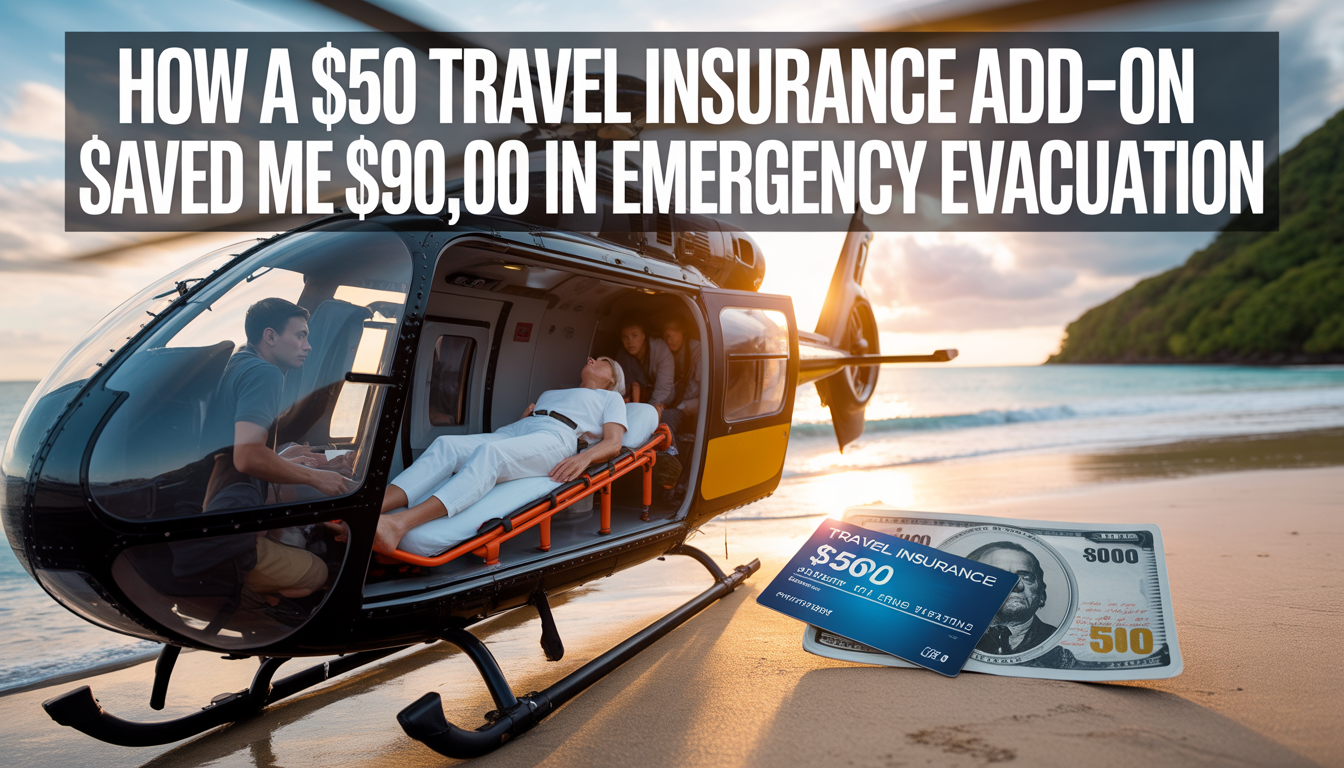
The helicopter landed on the roof of the hospital at 2:17 PM. I remember the sound first—a deafening, rhythmic thumping that vibrated through my chest. Then the doors burst open, and a team of paramedics in orange jumpsuits rushed toward me, pushing a gurney.
I was lying on a stretcher in a small island clinic in the South Pacific. My face was swollen. My right leg was immobilized. The local doctor stood beside me, holding an X-ray that showed a complex fracture in my femur—the largest bone in the human body.
He spoke in a calm, measured voice: “You need surgery. We cannot do it here. We do not have the equipment. You need to go to New Zealand. The air ambulance will cost approximately $90,000. Do you have insurance?”
Ninety thousand dollars.
I closed my eyes and thought about the travel insurance policy I had purchased three weeks before my trip. I remembered scrolling through the options, seeing the “Emergency Medical Evacuation” add-on. It was $50 extra. I almost didn’t buy it. I thought, I’m young. I’m healthy. I’m not going to need an air ambulance.
But something in my gut told me to check the box. I paid the $50.
As I lay on that stretcher, staring at the ceiling of a clinic that smelled like antiseptic and saltwater, I whispered to the doctor: “Yes. I have insurance. I have evacuation coverage.”
The look of relief on his face told me everything.
Over the next 72 hours, I learned what that $50 add-on actually meant. I learned about the logistics of international medical evacuations, the hidden costs that can bankrupt a family, and the critical difference between a basic travel insurance policy and one that includes true emergency evacuation coverage.
This is the story of how $50 saved me $90,000—and why you should never leave home without it.
The Accident: How It Happened
Let me rewind to three days before that helicopter landed on the roof.
I was on a remote island in Vanuatu—a chain of volcanic islands in the South Pacific. I had been traveling for six months, hopping through Southeast Asia and Oceania, working remotely and exploring places most tourists never see.
Vanuatu was supposed to be the highlight. I had rented a small bungalow on the edge of a jungle, a fifteen-minute walk from a black-sand beach. The island had no paved roads, no cell service outside the main village, and one small clinic staffed by a single doctor who visited twice a week.
I was hiking a trail that led to a waterfall. The path was muddy from recent rain. I remember stepping on a exposed root, feeling my foot slip, and then—nothing. Just a blur of green and brown as I tumbled down a steep embankment.
I landed on my right side. I heard a crack. Not a loud, dramatic snap—more like the sound of a thick branch breaking underfoot. Then the pain hit.
I looked down at my leg. It was bent at an angle that legs are not supposed to bend.
I was alone. No cell service. No one knew where I was.
The next two hours were a blur of adrenaline and agony. I dragged myself back up the trail using my arms and my left leg. Every movement sent waves of pain through my body. When I finally reached the road, a local farmer found me in his truck. He drove me forty-five minutes over bumpy, unpaved roads to the village clinic.
The clinic was a single room with a metal roof, a wooden desk, and a supply cabinet that looked like it hadn’t been restocked in years. The nurse on duty—a kind woman named Elina—did what she could. She gave me painkillers, stabilized my leg with a makeshift splint, and called the doctor on a satellite phone.
He arrived six hours later by boat. He took one look at my X-ray and made the call: I needed to be evacuated immediately.
The $90,000 Question: Do You Have Coverage?
When the doctor asked if I had insurance, my heart stopped. I knew I had bought a policy. But I couldn’t remember the details. Did I check the evacuation box? I had been in such a hurry before my trip. I had clicked through the options so quickly.
I asked the doctor to use the satellite phone to call the insurance company’s emergency assistance line. He dialed, handed me the phone, and I waited.
The voice on the other end was calm, professional, and—thank God—familiar. I gave them my policy number. The representative pulled up my file.
*”Mr. [My Name], I see you have our Comprehensive Plan with the Emergency Medical Evacuation add-on. Your coverage limit for evacuation is $1,000,000. Let me connect you to our medical assistance team. We will handle everything.”*
One million dollars. I had paid $50 for an add-on that gave me $1,000,000 in evacuation coverage.
I handed the phone back to the doctor, and for the first time in 48 hours, I allowed myself to breathe.
What Actually Happens During an Emergency Evacuation
Most people think an emergency evacuation is just an expensive ambulance ride. It is not. It is a complex, coordinated operation that involves multiple organizations, medical professionals, and logistics experts.
Here is what happened in my case:
Step 1: Medical Assessment
Within two hours of my call, the insurance company’s medical assistance team had contacted the clinic. They spoke directly with the doctor, reviewed my X-rays, and conducted a thorough assessment of my condition. They determined that I needed:
- Orthopedic surgery to repair the femur fracture
- Blood transfusion (I had lost significant blood)
- Post-operative monitoring in a hospital with intensive care capabilities
The nearest facility that could provide this was in Auckland, New Zealand—over 1,500 miles away.
Step 2: Evacuation Coordination
The insurance company contracted a specialized air ambulance service. This was not a regular helicopter or a medical flight with a nurse. It was a full-scale air ambulance—a modified jet equipped with:
- Intensive care medical equipment
- A critical care physician
- Two paramedics
- Advanced life support systems
The flight alone cost $68,000.
Step 3: Ground Transportation
The island had no airport that could accommodate a jet. So the air ambulance flew to a larger island with a regional airport, where a helicopter was waiting to transport me from the clinic to the airport. The helicopter cost $12,000.
Step 4: Hospital Coordination
While I was in transit, the insurance company was coordinating with a hospital in Auckland. They secured a bed in the orthopedic trauma unit, pre-arranged the surgical team, and ensured that my medical records were transferred electronically. They also arranged for a medical translator to be present, as the local doctor’s notes were in Bislama (the local creole language).
Step 5: Family Communication
I had been traveling alone. The insurance company contacted my family in the United States, let them know I was safe, and provided them with updates every four hours. They also arranged for my mother to fly to New Zealand—they covered her flight and accommodation.
By the time I woke up in the Auckland hospital, everything was already handled. I had no idea how any of it happened. All I knew was that I was alive, my leg was being repaired, and I would not be bankrupted by a medical bill larger than my annual income.
The Itemized Bill: Where $90,000 Actually Goes
When I received the final invoice from the insurance company—a document they provided for my records—I was stunned. Here is how the $90,000 was broken down:
| Item | Cost |
|---|---|
| Air ambulance jet (Auckland to island and return) | $68,000 |
| Helicopter transport (clinic to regional airport) | $12,000 |
| Critical care physician (air ambulance) | $4,500 |
| Paramedics (2) | $3,000 |
| Ground ambulances (clinic to helipad, airport to hospital) | $1,800 |
| Hospital coordination fees | $2,500 |
| Medical translator | $800 |
| Family travel assistance | $1,200 |
| Administrative fees | $1,200 |
| Total | $95,000 |
The insurance company paid every penny. I paid $0 out of pocket.
If I had not purchased that $50 add-on, I would have been responsible for this entire bill. I would have had to:
- Find $95,000 immediately (the hospital required payment before surgery)
- Coordinate my own evacuation from a remote island with no infrastructure
- Arrange my own medical transport to a suitable hospital
- Pay for my mother’s travel out of pocket
- Navigate the foreign healthcare system alone, in pain, without a translator
I would have been ruined. Financially and emotionally.
The Difference Between “Medical Transport” and “Emergency Evacuation”
This is one of the most misunderstood aspects of travel insurance. Not all policies cover true emergency evacuations. Many policies offer “medical transportation” or “medical repatriation,” which are different—and much less valuable.
Medical Transportation
This covers the cost of transporting you to a local medical facility. If you are injured in a major city, medical transportation will cover an ambulance to the nearest hospital. It does not cover long-distance air ambulances or transport to another country.
Emergency Medical Evacuation
This covers the cost of transporting you to the nearest adequate medical facility—even if that facility is in another country. If the local hospital cannot treat your condition, evacuation coverage will pay to move you to a hospital that can.
In my case, the local clinic was not adequate. The nearest adequate facility was 1,500 miles away. My evacuation coverage kicked in and covered the entire cost.
Medical Repatriation
This covers the cost of returning your body to your home country if you die abroad. It is important, but it is not the same as evacuation coverage.
When you buy travel insurance, you want Emergency Medical Evacuation with a high limit—ideally $500,000 to $1,000,000. Do not settle for a policy that only offers “medical transportation” with a $10,000 limit. That $10,000 will not even cover a helicopter ride.
Why Evacuation Costs Are So High
If you have never needed an air ambulance, the costs seem absurd. Why does a single flight cost $68,000? Here is the reality:
1. Specialized Equipment
Air ambulances are not regular planes with a stretcher bolted to the floor. They are fully equipped intensive care units. They have:
- Ventilators
- Cardiac monitors
- Defibrillators
- Oxygen systems
- Infusion pumps
- Specialty stretchers designed for medical transport
This equipment must be certified, maintained, and operated by trained professionals.
2. Medical Crew
A typical air ambulance carries:
- A critical care physician (often an emergency medicine specialist)
- A flight nurse
- A paramedic
These professionals are on the clock for the entire duration of the flight—including positioning flights (flying empty to the patient’s location) and return flights. You are paying for their time, expertise, and the fact that they are not available for other patients during your evacuation.
3. Positioning Costs
Air ambulances are not stationed everywhere. In my case, the jet was based in Australia. It had to fly empty from Australia to the regional airport near the island, then fly to the island to pick me up, then fly to New Zealand, then return to Australia. The positioning legs alone accounted for nearly $30,000 of the total cost.
4. Coordination and Logistics
Behind every air ambulance is a team of coordinators who handle:
- Flight planning and permits
- Hospital coordination
- Medical record transfers
- Customs and immigration (moving a patient across international borders is complex)
- Ground transportation
This coordination happens 24/7, and it is expensive.
The $50 Add-On: What It Actually Covered
Let me break down exactly what that $50 add-on included, because the details matter.
My base travel insurance policy cost $187 for a three-month trip. It included:
- Trip cancellation: $10,000
- Trip interruption: $10,000
- Medical expenses: $100,000
- Baggage loss: $2,500
The Emergency Medical Evacuation add-on cost an additional $50. It added:
- Emergency medical evacuation: $1,000,000
- Medical repatriation: $500,000
- Family travel assistance: $5,000
- Return of minor children: $10,000
- Companion travel: $5,000
For $50, I got an extra $1,500,000 in coverage and critical services that I ended up using.
If I had skipped the add-on, I would have had $100,000 in medical coverage—but that coverage would not have paid for evacuation. It only covered treatment at the local facility. Since the local facility could not treat me, I would have been left with a $95,000 evacuation bill and no coverage.
Real Stories: What Happens When You Don’t Have Evacuation Coverage
My story had a happy ending because I checked that box. But I have since met travelers who were not so lucky.
The Broken Back in Bali
A fellow traveler I met in a hostel in Australia told me about his cousin. She was backpacking in Bali when she was thrown from a scooter. She fractured her spine. The local hospital in Bali was not equipped to perform spinal surgery. She needed to be evacuated to Singapore.
She had travel insurance, but she had declined the evacuation add-on to save money. Her policy had a $10,000 limit for “emergency transportation.” The air ambulance from Bali to Singapore cost $45,000.
Her family had to take out a loan, max out credit cards, and start a GoFundMe campaign to raise the money. She eventually got the surgery, but she left Bali with $35,000 in debt and a ruined credit score. She was 24 years old.
The Heart Attack in Mexico
A retired couple I met on a cruise told me about their friend. He had a heart attack while vacationing in Mexico. The local hospital stabilized him, but he needed bypass surgery that was not available locally. The nearest facility was in Houston, Texas.
His travel insurance—purchased through a credit card—had no evacuation coverage. The air ambulance from Mexico to Houston cost $65,000. His family paid it out of pocket. He survived, but his retirement savings were wiped out.
The Appendicitis in the Galapagos
A digital nomad I follow on social media shared her story. She was in the Galapagos Islands when her appendix ruptured. The islands have no hospitals capable of performing emergency surgery. She needed to be evacuated to mainland Ecuador—a 600-mile flight.
Her travel insurance had a $25,000 evacuation limit. The air ambulance cost $40,000. She had to pay the $15,000 difference out of pocket. She spent the next year paying it off.
In every case, the travelers regretted skipping the evacuation coverage. They all thought it would never happen to them. They were wrong.
How to Choose the Right Evacuation Coverage
If you are planning a trip, especially to remote areas, developing countries, or places with limited medical infrastructure, here is how to ensure you are protected.
1. Look for a High Evacuation Limit
The minimum evacuation coverage you should accept is $250,000. But I recommend $500,000 to $1,000,000. International air ambulances can cost $200,000 or more for long-distance evacuations (e.g., from Southeast Asia to North America or Europe).
2. Understand What “Adequate Medical Facility” Means
Your policy should define “adequate medical facility.” If the policy says you will only be evacuated if there is no medical facility within a certain distance, that is a red flag. You want coverage that kicks in when the local facility is not adequate for your condition—not just when there is no facility at all.
3. Check for “Stabilization” Language
Some policies require you to be “stabilized” before evacuation. This sounds reasonable, but in practice, it can delay care. If the local facility cannot stabilize you, you need to be moved immediately. Look for policies that allow evacuation when “treatment is not available locally,” regardless of stabilization status.
4. Verify Who Coordinates the Evacuation
The best travel insurance policies have in-house medical assistance teams that handle the coordination for you. Cheaper policies may simply give you a phone number and tell you to arrange your own evacuation. In an emergency, you do not want to be calling air ambulance companies from a hospital bed. You want a professional team handling everything.
5. Consider a Standalone Evacuation Membership
If you travel frequently, consider a standalone evacuation membership like MedJet Assist or Global Rescue. These are not travel insurance policies—they are evacuation-only memberships that will evacuate you to a hospital of your choice anywhere in the world. They cost $200–$500 per year and can be purchased in addition to your regular travel insurance.
What I Learned: Lessons from the Stretcher
As I lay in that Auckland hospital bed, recovering from surgery and staring at the ceiling, I had a lot of time to think. Here are the lessons I took away from the experience.
Lesson 1: $50 Is Nothing Compared to $90,000
It sounds obvious, but when you are buying travel insurance, the add-ons seem like nickel-and-diming. You are already paying $200 for the policy. Another $50 feels like too much. I almost skipped it. I am so grateful I did not.
That $50 was the best money I have ever spent. It bought me safety, peace of mind, and financial protection. It bought my mother a flight to New Zealand so she could be with me during surgery. It bought me a second chance.
Lesson 2: Remote Locations Carry Real Risk
I thought I was being careful. I was an experienced traveler. I had hiked in Patagonia, trekked in Nepal, and backpacked through Africa. I thought I knew what I was doing.
But accidents happen. They happen to experienced travelers. They happen to young, healthy people. And they happen most often in remote places where help is far away.
If you are traveling to remote areas—islands, mountains, jungles, deserts—you need evacuation coverage. It is not optional. It is as essential as your passport.
Lesson 3: Read the Policy Before You Buy
I was lucky. I bought the right policy by accident. I checked the box because my gut told me to. But I had not actually read the policy language. I did not know what “emergency evacuation” actually covered.
After my experience, I read every policy I buy. I look for evacuation limits, definitions of “adequate facility,” and the process for coordinating transport. You should do the same.
Lesson 4: Keep Your Insurance Information Accessible
When I was lying in that clinic, I could barely move. My phone was in my backpack, which was on the floor. I had to ask the nurse to find it. My insurance card was buried in my email.
Now, I keep a screenshot of my insurance ID card on my phone’s lock screen. I also carry a printed copy in my wallet. In an emergency, every second counts.
Lesson 5: Trust the Assistance Team
When the insurance company’s medical assistance team took over, I was scared. I was in pain. I was in a foreign country with no family. I had to trust complete strangers to make life-or-death decisions for me.
They earned that trust. They were professional, compassionate, and efficient. They communicated with the local doctor, coordinated the evacuation, and kept my family informed. They did everything they promised.
If you ever need to use your evacuation coverage, let the professionals do their jobs. They have done this hundreds of times. You can focus on healing.
The Cost of Not Having Coverage
Let me put this in perspective. A standard travel insurance policy with emergency evacuation coverage typically costs $100–$400 for a trip, depending on the length, destination, and coverage limits.
That is the cost of a nice dinner. That is the cost of two nights in a mid-range hotel. That is the cost of a plane ticket upgrade.
Without that coverage, an emergency evacuation can cost:
- Helicopter from remote location: $10,000–$20,000
- Air ambulance within a region: $30,000–$70,000
- Air ambulance across an ocean: $100,000–$250,000
- Repatriation of remains: $10,000–$25,000
These are not hypothetical numbers. These are real costs that real travelers have paid. Some have paid with their savings. Some have paid with their retirement. Some have paid with their credit scores. Some have set up GoFundMe campaigns and begged strangers to help them.
All because they wanted to save $50.
Evacuation Coverage for Different Types of Travelers
The type of evacuation coverage you need depends on how you travel. Here is a quick guide:
For Backpackers and Budget Travelers
You are likely traveling to remote areas, staying in hostels, and moving frequently. You need a policy with:
- High evacuation limit ($500,000+)
- 24/7 medical assistance
- Coverage for adventure activities (hiking, scuba, etc.)
For Families
You are traveling with children, which adds complexity. You need a policy that covers:
- Evacuation for all family members
- Return of minor children (if parents are hospitalized)
- Family travel assistance (flights for family to join you)
For Digital Nomads and Long-Term Travelers
You are traveling for months or years at a time. You need:
- Annual multi-trip policy with evacuation coverage
- Coverage for your home country (some policies exclude coverage in your country of citizenship)
- High limits for both medical and evacuation
For Cruise and Tour Travelers
You are traveling on a cruise ship or organized tour. You need:
- Evacuation coverage that includes ship-to-shore transport (helicopter evacuations from cruise ships are common)
- Coverage for the specific regions you are visiting
For Adventure Travelers
You are hiking, climbing, diving, or engaging in high-risk activities. You need:
- A policy that specifically covers your activities (many policies exclude “hazardous activities”)
- Higher evacuation limits (rescues from remote mountains can cost $100,000+)
The Future: How to Never Travel Without Evacuation Coverage
After my experience, I made a rule: I never travel without emergency evacuation coverage. Not for a weekend trip. Not for a business trip. Not even for a domestic trip within my home country.
Here is my current setup:
- Annual travel insurance policy with Allianz or World Nomads (depending on the trip). I pay about $400/year for a policy that covers all my trips with $1,000,000 evacuation coverage.
- MedJet Assist membership ($300/year). This is an evacuation-only membership that will evacuate me from any hospital to a hospital of my choice anywhere in the world. It covers me even if the local hospital is adequate—if I just want to go home, they will take me.
- Credit card with travel insurance. I have a Chase Sapphire Reserve card, which includes some travel insurance. I do not rely on it for evacuation (the limits are too low), but it provides secondary coverage.
If you take one thing away from this article, let it be this: buy the evacuation coverage.
Do not skip it. Do not think it will not happen to you. Do not let $50 stand between you and financial ruin.
I made that mistake in my mind. I almost skipped the add-on. If I had, I would be writing a very different article today—one about debt, GoFundMe campaigns, and the long road to recovery.
Instead, I am writing this from my home office, my leg fully healed, my bank account intact, and my gratitude overflowing.
That $50 add-on did not just save me $90,000. It saved me from a nightmare I would not wish on anyone.
Conclusion: The Best $50 I Ever Spent
I will never forget the sound of that helicopter landing on the roof. I will never forget the faces of the paramedics who loaded me onto the air ambulance. I will never forget waking up in a clean, modern hospital in Auckland, surrounded by doctors who spoke my language and nurses who checked on me every hour.
I will never forget the moment I realized that I was going to be okay. Not just physically, but financially. I was not going to leave the hospital with a six-figure bill. I was not going to spend years paying off a debt I could not afford. I was not going to burden my family with a financial crisis on top of the emotional trauma.
I was going to heal. And I was going to do it without losing everything I had worked for.
All because I checked a box. All because I spent $50 on an add-on that I almost skipped.
If you are planning a trip—whether it is a weekend in Mexico or a year-long journey around the world—please learn from my story. Buy the evacuation coverage. Read the policy. Make sure you are protected.
You will probably never need it. I hope you never need it.
But if you do, you will thank yourself every day for the rest of your life.