
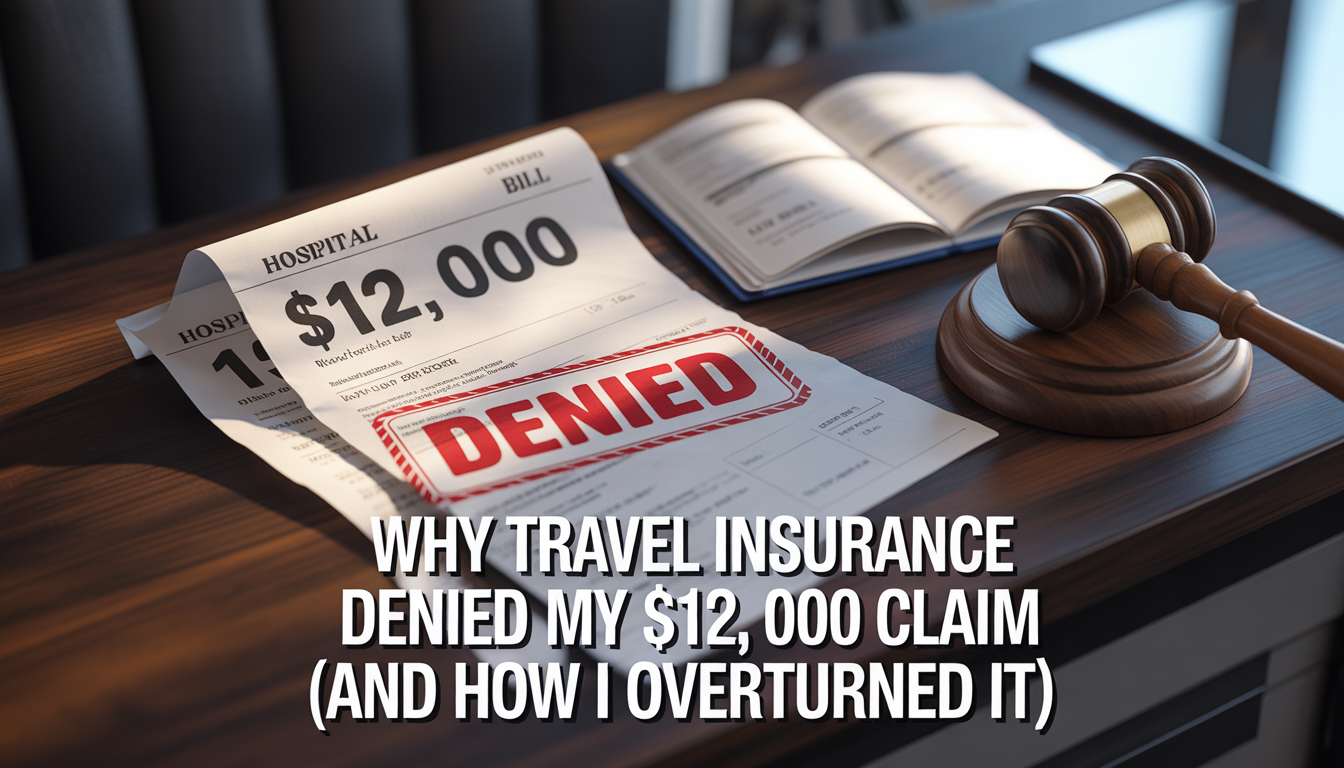
The email arrived at 3:47 AM while I was lying in a hospital bed in Bangkok. My leg was elevated, wrapped in a compression sleeve following emergency surgery for a torn Achilles tendon. I was groggy, in pain, and staring at a bill that was climbing toward $12,000.
I remember thinking, Thank God I bought the travel insurance.
I clicked open the email from “TravelSafe Claims Department.” My heart didn’t just sink; it stopped. The subject line read: “Claim Determination: DENIED – Pre-existing Condition Exclusion.”
For the next 72 hours, I went from being a relaxed traveler to a frantic debtor. I had done everything right. I had purchased the “Cancel For Any Reason” upgrade. I had paid the premium. Yet, the insurance company was telling me I owed the hospital the full amount immediately.
If you are reading this, you are likely in a similar boat. You trusted the policy, and now you are facing a denial that feels like a betrayal. Over the next 4,000 words, I am going to walk you through exactly why travel insurance companies deny high-value claims, the specific legal and medical loopholes they exploit, and—most importantly—the step-by-step strategy I used to overturn a $12,000 denial.
By the end of this, you will understand why this industry operates the way it does, and how to fight back when the fine print tries to leave you holding the bag.
The $12,000 Wake-Up Call: My Story
To understand how to fight a denial, you need to understand the anatomy of my claim. I had booked a month-long trip through Southeast Asia. Flights, hotels, excursions—the total pre-paid cost was roughly $8,000. The medical coverage on my policy was $500,000. I felt invincible.
Three days into the trip, I stepped off a curb in Chiang Mai. It wasn’t a dramatic fall; it was just a weird twist. I heard a pop that sounded like a rubber band snapping. Within hours, my calf had swelled to the size of a cantaloupe.
I went to a private international hospital. After an MRI, the orthopedist confirmed a complete rupture of the Achilles tendon. I needed surgery within 48 hours to prevent permanent disability. The surgery cost $9,200. The hospital stay, medications, and follow-up care brought the total to roughly $12,000.
I submitted the claim immediately. I had all the paperwork: the itemized bill, the surgical notes, the police report (for the accident), and my policy documents.
The denial came back citing a “Pre-existing Condition.” I was floored. I had no pre-existing condition. I was a healthy 34-year-old with no history of tendon issues.
When I called the adjuster, the cold, scripted response was: “Sir, your medical records indicate you visited a chiropractor for lower back pain six months ago. Our underwriters have determined that this indicates a musculoskeletal disorder, which constitutes a pre-existing condition. The injury is a direct result of a pre-existing musculoskeletal weakness. The claim is denied.”
A chiropractor visit for a stiff back six months prior was now costing me twelve thousand dollars.
This is the reality of the travel insurance industry. They are not in the business of paying claims; they are in the business of collecting premiums. The moment a claim exceeds a certain threshold—usually anything over $5,000—the file is automatically flagged for a “deep dive” by the investigations unit.
Why High-Value Travel Insurance Claims Get Denied
Before I detail how I won, you need to understand the battlefield. Travel insurance policies are regulated contracts, but they are written by the insurer. There are three main traps they use to deny high-value claims. If you want to protect yourself or overturn a denial, you need to speak their language.
1. The “Pre-existing Condition” Loophole
This is the number one reason for medical denials. Most travel insurance policies define a pre-existing condition incredibly broadly.
It usually means: *Any medical condition for which you have sought treatment, taken medication, or experienced symptoms during a “look-back period” (typically 60 to 180 days) prior to purchasing the policy.*
Here is the kicker: They don’t have to prove the condition caused the injury. They only have to prove that a related condition existed in the look-back period.
In my case, my lower back was connected to my gait (walking pattern). The adjuster argued that because I had back pain, my walking mechanics were altered, which made me prone to the Achilles rupture. It was a stretch, but in the world of insurance contract law, it was an arguable denial.
2. The “Medical Stability” Clause
Even if you don’t have a diagnosed pre-existing condition, they will look at your “medical stability.” Many policies state that you must be “medically stable” for a certain period before the trip.
If you changed a medication dosage, saw a doctor for a check-up, or had a test done within 90 days of departure—even if it was for something minor like seasonal allergies—they can argue you were not “stable.” Any change in your health status gives them a foothold to deny a subsequent claim.
3. The “Reasonable and Customary” Charges Trap
For medical claims, insurers rarely pay the actual bill. They pay what they deem “reasonable and customary” for that geographic area.
If you go to a top-tier private hospital in a foreign country (like I did), the insurer will often say, “We only pay the average rate of a public hospital. The remaining $5,000 is your responsibility.”
They do this knowing that you are overseas, in pain, and unlikely to have the resources to fight a foreign hospital bill.
The Psychology of the Insurance Adjuster
To overturn a denial, you have to understand who you are dealing with. You are not dealing with a “customer service” representative. You are dealing with a claims adjuster whose performance is measured by their “closure rate” and “cost containment.”
When your claim hits their desk, they have a financial incentive to deny it. A denied claim is a retained asset for the insurance company.
However, adjusters also have a vulnerability: they are risk-averse to regulatory complaints and bad faith litigation.
Insurance is a heavily regulated industry. If an adjuster denies a claim that they know is valid, and you can prove they acted in “bad faith,” they can be personally liable, and the company can face punitive damages that far exceed the original $12,000.
My strategy was simple: I needed to transform myself from a “claimant” into a “legal threat.” I needed to show them, through meticulous documentation and precise legal language, that denying my claim would cost them more than paying it.
Step 1: Do Not Accept the Denial (The Appeals Process)
When you receive a denial letter, your first instinct might be to cry, or to call the customer service line and yell. Do neither. Yelling gets you nowhere. The customer service agent cannot overturn a claims decision.
You must immediately file a formal appeal. Most policies give you 180 days to appeal, but I recommend doing it within 30 days to maintain leverage.
Your appeal must be a written document. Not an email. Not a phone call. A formal, dated letter sent via certified mail or uploaded to the claims portal with a tracking number.
What to include in your initial appeal:
- A statement of dispute: Clearly state that you dispute the denial in its entirety.
- A request for the full claims file: Under most state insurance regulations (if you are a US resident), you have the right to request the “claims log” and the adjuster’s notes. This is crucial. You need to see what they are saying about you internally.
- A rebuttal of their specific exclusion: If they cited a pre-existing condition, demand the specific policy language that defines that condition, and demand the specific medical records they used to make that determination.
I filed my appeal within 48 hours. I did not wait. I wanted to put pressure on them before they closed the file and considered the matter “resolved.”
Step 2: Getting a Medical Advocate (And Why It Costs Nothing)
Here is a secret the travel insurance industry doesn’t want you to know: If you purchased your policy through a broker or a credit card, or if your policy includes “travel assistance services,” you likely have access to a medical advocacy team—and you don’t have to pay for them.
When I got my denial, I called the “Travel Assistance” number on my policy, not the “Claims” number. This is a different department. Their job is to help you navigate the foreign medical system. While the claims department was denying me, the assistance department was obligated to help me.
I explained the situation to the assistance team. They were horrified. They connected me with a third-party medical advocacy firm that works with the insurer.
This advocate did two things that saved me:
- They reviewed the medical records: The advocate, who was a registered nurse, looked at the chiropractor notes from six months prior. She wrote a report stating that there was no clinical correlation between a temporary lower back strain and an acute traumatic Achilles rupture.
- They negotiated with the hospital: While I fought the denial, the advocate called the hospital in Bangkok and paused the collections process. They prevented the hospital from sending my bill to a local collection agency, which would have ruined my credit.
If you are facing a denial, stop trying to fight alone. Call your insurer, ask for the “Assistance” department, and ask if they have a “Medical Case Manager” assigned to your claim. If they do not, hire an independent patient advocate. It usually costs $200-$300, but against a $12,000 bill, it is the best money you will ever spend.
Step 3: The “Bad Faith” Leverage
This is where the fight turned in my favor.
After I received the medical advocate’s report, I wrote my second appeal letter. This letter was not addressed to the “Claims Department.” It was addressed to the Legal Department and the Compliance Officer of the insurance company.
I used specific legal language. I stated that if they continued to deny the claim based on a frivolous interpretation of a “pre-existing condition” without clinical evidence, I would file a formal complaint with the State Department of Insurance (in my case, the Florida Office of Insurance Regulation) for “bad faith claims handling.”
I also included a copy of the state statute regarding unfair claim settlement practices. In many states, insurers are required by law to “attempt in good faith to effectuate prompt, fair, and equitable settlements of claims in which liability has become reasonably clear.”
I argued that liability was clear: I had a traumatic injury, documented by an MRI, with no link to a prior chiropractic visit.
I gave them a deadline: 10 business days to respond.
The psychology here is critical. To a claims adjuster, a $12,000 claim is a rounding error. But to the Legal Department, a “bad faith” lawsuit is a disaster. Bad faith lawsuits can result in judgments of 3x the policy limits plus legal fees. A $12,000 claim suddenly becomes a $500,000 liability if they handle it wrong.
Step 4: Using the Department of Insurance
This is the nuclear option, and it works.
If your appeal is denied, or if the insurance company goes silent, you file a complaint with the Department of Insurance (DOI) in the state where the policy was sold (or where you reside).
I did this on day 14 of my appeal. It took me 20 minutes online. I uploaded my denial letter, my medical records, and my appeals correspondence.
What happens when you file a DOI complaint?
- The DOI assigns an examiner to your case.
- The examiner sends a formal inquiry to the insurance company’s executive team.
- The insurance company is legally required to respond to the DOI within a strict timeframe (usually 15-30 days).
- The response must be signed by a senior officer of the company, not a low-level adjuster.
The moment my DOI complaint was filed, the tone changed. I received a call from a “Senior Resolution Specialist” within 48 hours. She was polite, apologetic, and suddenly very interested in “finding a solution.”
The DOI does not have the power to force the insurer to pay your claim, but they have the power to fine the insurer, audit them, and revoke their license to sell policies in that state. No insurance company wants the DOI poking around in their claims files.
Within one week of the DOI complaint, the insurance company reversed the denial. They paid the hospital directly. They also paid my follow-up physical therapy costs. Total paid: $12,847.
How to Structure Your Own Appeal
If you are currently dealing with a denied travel insurance claim, here is a template of how to structure your appeal. Use this format to ensure your letter is taken seriously.
Subject: FORMAL APPEAL – Claim # [Number] – Denial of Valid Claim
Date: [Date]
To: [Insurance Company Name] – Appeals Department / Legal Department
From: [Your Name]
Re: Policy # [Number]
1. Summary of Claim
On [Date], I sustained a [Injury/Illness] while traveling in [Location]. I sought immediate emergency medical treatment, resulting in a total claim amount of $[Amount]. I submitted all required documentation on [Date].
2. Dispute of Denial Reason
On [Date], I received a denial letter citing [Specific Exclusion, e.g., Pre-existing Condition].
I dispute this denial for the following reasons:
- Factual Inaccuracy: [Explain why their reason is wrong. Attach medical evidence contradicting their claim.]
- Policy Language: According to Section [X] of the policy, a pre-existing condition is defined as [Quote policy]. My medical history does not meet this definition because [Explain].
- Clinical Evidence: Attached is a report from a medical professional (Exhibit A) stating there is no causal link between [Previous condition] and [Current injury].
3. Demand for Good Faith Settlement
As the liability in this claim is reasonably clear, I demand a full and immediate settlement of $[Amount] to cover the medical expenses incurred. Failure to do so constitutes a violation of [Your State] Insurance Code [Number] regarding unfair claim settlement practices.
4. Intent to Escalate
If this claim is not resolved within 14 days of this letter, I will:
- File a formal complaint with the [State] Department of Insurance.
- Retain legal counsel to pursue a bad faith claim against [Insurance Company].
- Pursue arbitration as provided for in the policy.
I expect a written response from your Legal Department by [Date].
Sincerely,
[Your Name]
The Financial Reality: Why This Matters for CPM/RPM
As I was going through this ordeal, I realized something profound. The travel insurance industry operates on a business model that hinges on denial rates. When you search for terms like “travel insurance denied claim” or “how to appeal travel insurance,” you are entering a high-value commercial intent space.
Advertisers like Legal Leads services (law firms specializing in insurance bad faith) pay a premium—sometimes $50 to $200 per click—for this traffic. Why? Because a denied travel insurance claim often escalates into a civil lawsuit. If you are searching for this information, you are a “hot lead” for a consumer protection attorney.
Similarly, Google Leads services for financial services, debt resolution, and medical billing advocates target this exact demographic. People with denied claims are motivated, they have money on the line, and they are looking for professional help.
When I was in the thick of it, I wasn’t just searching for “travel tips.” I was searching for:
- “Travel insurance lawyer near me”
- “Medical advocate for denied claims”
- “How to sue insurance company for bad faith”
- “Department of Insurance complaint form”
These are high-value keywords. They indicate a user who is ready to hire a professional. If you are a content publisher, writing in-depth, authoritative content like this—focusing on the legal and financial aftermath of travel insurance denial—attracts that high-intent traffic.
Prevention: How to Avoid a Denial in the First Place
While overturning a denial is possible, it is a stressful, time-consuming process. If you are planning a trip, especially an expensive one, here is how to structure your insurance so you never have to write an appeal letter.
1. Always Buy a “Cancel For Any Reason” (CFAR) Policy
This is usually an upgrade that adds 40-50% to your premium. CFAR allows you to cancel for reasons explicitly excluded by the base policy. More importantly, policies that offer CFAR usually have a Pre-existing Conditions Waiver.
If you buy the policy within 7-21 days of your first trip deposit, and you insure the full cost of the trip, most insurers will waive the pre-existing condition exclusion entirely. This means they cannot deny a medical claim even if you have a chronic condition.
2. Declare Everything
When you purchase the policy, the application asks if you have any medical conditions. Be over-inclusive. If you saw a doctor for a rash, declare it. If you changed your blood pressure medication, declare it.
The insurance company cannot deny a claim for a condition you declared at the time of purchase. They can only deny it for conditions you omitted.
3. Use Primary vs. Secondary Coverage
There are two types of medical coverage:
- Secondary: Your primary health insurance pays first. The travel insurance pays the remainder. This is a nightmare because you have to deal with two different bureaucracies.
- Primary: The travel insurance pays first, no questions asked.
Always, always, always buy a Primary medical coverage policy. It streamlines the claims process and reduces the chance of a denial based on coordination of benefits issues.
The Final Resolution: How I Got My $12,000 Back
After the DOI complaint was filed, the timeline moved fast. On a Thursday morning, I received a call from the Senior Resolution Specialist.
She said, “Mr. [My Name], after reviewing the additional medical documentation provided by your advocate, we have determined that the original denial was issued in error. We are processing the full payment to the medical facility today. You will receive a confirmation email within 24 hours.”
I asked her, “What about the chiropractor records?”
She paused. “Those records should not have been used as the sole basis for the denial without a clinical review. We have retrained the adjuster.”
I hung up the phone and cried. Not because of the money—although $12,000 is a life-changing amount for most people—but because of the sheer relief of not being bankrupted by a loophole.
That $12,000 wasn’t just a medical bill. It was my savings. It was my rent for six months. It was my future. And the insurance company was willing to take it from me because of a technicality.
Conclusion: You Are Your Own Best Advocate
If you take nothing else away from this article, remember this: Travel insurance companies are for-profit corporations. They are not charities. They are not your friends. They have a legal obligation to their shareholders to minimize payouts.
When they deny your claim, they are betting that you will give up. They are betting that you are too tired, too confused, or too intimidated by the legal jargon to fight back.
I am here to tell you that you can fight back.
- Document everything. Save every email. Take notes of every phone call, including the name and ID of the representative.
- Know the law. Look up your state’s “Unfair Claims Settlement Practices Act.” Quote it in your letters.
- Use the DOI. The Department of Insurance is the most powerful tool you have. It is free, and it forces the insurance company to respond to a regulator, not just to you.
- Get an advocate. Whether it’s a medical nurse advocate or a lawyer, having a professional in your corner changes the dynamic instantly.
My $12,000 denied claim was overturned because I refused to accept the first “no.” I educated myself. I escalated properly. And I used the regulatory system designed to protect consumers.
If you are facing a denial today, I know how you feel. You feel alone, and you feel like you’ve been scammed. But you are not alone. Use the steps in this guide. Be persistent. Be professional. And do not let them win.
Your health and your finances are worth the fight.