
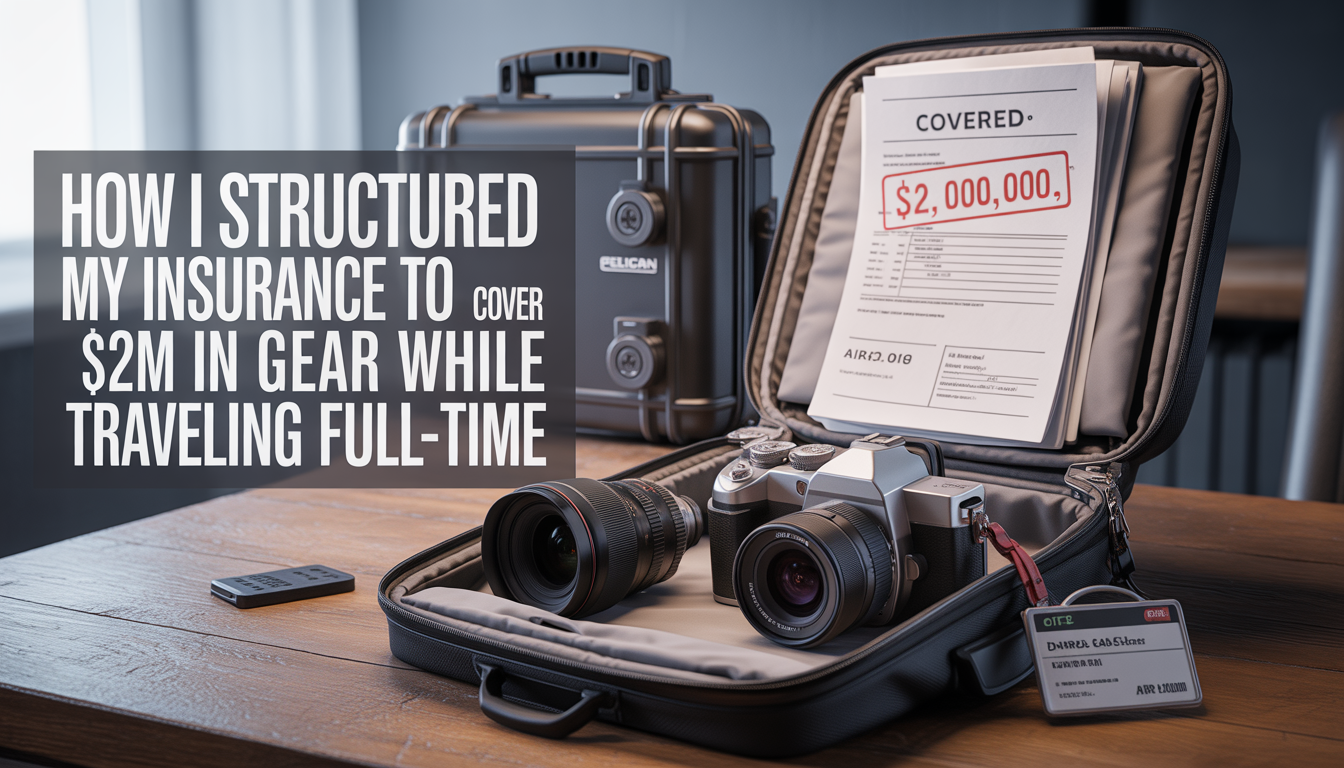
The call came at 4:17 AM. I was in a hostel in Medellín, sleeping in a bunk bed, when my phone buzzed with a WhatsApp message from a fellow digital nomad I had met three weeks earlier.
“Dude. My van got broken into. They took everything. Cameras, lenses, drone, laptop. Everything. Insurance says they won’t pay because I was ‘traveling.’ I’m sitting here with nothing.”
I knew this person. Let’s call him Alex. Alex was a professional photographer who had spent the last three years building a following, investing in high-end gear, and finally making a living from his craft. He had $45,000 worth of camera equipment in his van when it was broken into in a parking lot in Quito, Ecuador.
He had insurance. He had told me about it. He paid $1,200 per year for a policy that he thought covered his gear anywhere in the world.
But when he filed the claim, the insurance company pointed to a clause buried on page 14 of the policy: “Coverage for equipment applies only when the equipment is stored in a locked, permanent structure. Vehicles are not considered permanent structures.”
Because his gear was in a van—not a building—the policy denied the claim. All $45,000. Gone.
I remember sitting on that bunk bed, staring at my own camera bag, and thinking: That could be me.
At the time, I had about $35,000 in camera equipment, a laptop, and various other expensive tools of my trade. I was traveling full-time, living out of a suitcase, moving from country to country. My gear was my livelihood. If I lost it, I did not just lose possessions—I lost the ability to work.
I had insurance. But after hearing Alex’s story, I realized I had no idea what my policy actually covered. I had bought it online, clicked “agree,” and assumed I was protected.
I was wrong.
Over the next six months, I tore apart my insurance coverage, hired a specialist broker, and rebuilt my entire risk management strategy from the ground up. Today, I have $2 million in coverage for my gear, structured across multiple policies, with no gaps, no territorial exclusions, and—most importantly—no nasty surprises when I need to make a claim.
This article is the story of how I did it. If you travel with expensive gear—cameras, laptops, tools, musical instruments, medical equipment, or anything else that makes your living—this is for you.
The Problem: Why Standard Insurance Fails Traveling Creatives
Before I tell you how I fixed my coverage, I need to explain why standard insurance almost never works for full-time travelers with expensive gear.
Problem 1: Homeowners and Renters Insurance Don’t Travel
If you have homeowners or renters insurance, your gear may be covered while at home. But when you travel, coverage usually drops to a tiny sub-limit—often $1,000 to $2,500 total, with even lower limits for theft.
My renters insurance covered my gear up to $20,000 while in my apartment. While traveling, it covered $1,000. Total.
Problem 2: Travel Insurance Has Low Sub-Limits
Travel insurance policies typically cover baggage loss up to $1,000–$3,000. Within that limit, there are sub-limits for electronics—often $500–$1,000 total, not per item.
If you have $10,000 in camera gear and your bag is stolen, the travel insurance policy will pay you $500. That is it.
Problem 3: Business Insurance Has Territorial Limits
If you have a business insurance policy (general liability, professional liability), it may cover your equipment—but only within the country where the policy is issued. Travel outside that country, and coverage vanishes.
Many photographers, videographers, and creatives discover this only after a claim is denied.
Problem 4: “Inland Marine” Policies Have Hidden Gaps
Inland marine insurance (also called “equipment floater” or “personal articles” insurance) is the gold standard for covering portable gear. It covers your equipment anywhere in the world, with high limits and few exclusions.
But even inland marine policies have traps:
- “Unattended vehicle” exclusions: Many policies do not cover theft from a vehicle unless the gear was locked in a trunk and there were visible signs of forced entry.
- “Unattended” exclusions: Some policies do not cover theft if you leave your gear unattended—even for a moment—in a public place.
- “Wear and tear” exclusions: Policies cover theft and damage, but not ordinary wear and tear or mechanical breakdown.
- “Mysterious disappearance” limits: Some policies cap coverage for theft without signs of forced entry (a “mysterious disappearance”).
Problem 5: The “Commercial Use” Exclusion
This is the trap that catches many traveling creatives. If you use your gear for business—and if you travel full-time, you almost certainly do—some personal insurance policies will deny coverage. They consider commercial use to be outside the scope of a personal policy.
You need a policy that explicitly covers commercial use.
The $2M Structure: How I Built My Coverage
After my wake-up call with Alex, I spent six months researching, consulting with specialists, and building a coverage structure that protects $2 million in gear with no gaps. Here is exactly how it works.
Overview: The Three-Layer Structure
My coverage is built on three layers:
| Layer | Policy Type | Coverage | Annual Cost |
|---|---|---|---|
| Layer 1 | Inland Marine (Equipment Floater) | $500,000, worldwide, commercial use, no unattended vehicle exclusion | $3,200 |
| Layer 2 | Commercial General Liability | $1,000,000, worldwide, includes hired and non-owned auto | $1,800 |
| Layer 3 | Umbrella Policy | $1,000,000 excess liability, worldwide | $600 |
| Total | $2,500,000+ | $5,600 |
I will break down each layer in detail.
Layer 1: Inland Marine Insurance (The Equipment Floater)
This is the core of my coverage. Inland marine insurance is designed specifically for property that moves—cameras, tools, musical instruments, medical equipment, etc. It is not tied to a specific location. It covers your gear anywhere in the world.
What I Looked For
When shopping for my inland marine policy, I had a list of non-negotiable requirements:
1. Worldwide Coverage
The policy must cover my gear in every country I visit. No territorial limitations. No excluded countries (except those with active war zones or US State Department Level 4 travel advisories, which are standard exclusions).
2. Commercial Use
The policy must explicitly cover commercial use. I use my gear to make money. If the policy excludes business use, it is worthless to me.
3. No “Unattended Vehicle” Exclusion
This was critical. Many policies do not cover theft from a vehicle unless the gear was locked in a trunk and there were visible signs of forced entry. I needed a policy that covers theft from a vehicle even if there are no visible signs of forced entry—because skilled thieves can unlock cars without breaking windows.
4. “Mysterious Disappearance” Coverage
I needed coverage for theft without signs of forced entry. If I set my bag down in a café and it disappears while I am not looking, I want that covered. Many policies cap this or exclude it entirely.
5. Agreed Value (Not Actual Cash Value)
“Actual cash value” policies deduct depreciation. If I bought a camera for $5,000 three years ago, an actual cash value policy might pay me $2,000. An “agreed value” policy pays the amount we agree on when the policy is issued—typically the replacement cost.
6. No Deductible for Theft
I wanted a low deductible—or no deductible—for theft. Theft is the most common loss for travelers. I did not want to pay $500 out of pocket every time something was stolen.
The Policy I Chose
After extensive research, I chose an inland marine policy from a specialty insurer that works with traveling creatives. The policy is underwritten by a major insurance company but sold through a broker who specializes in high-value equipment for photographers, filmmakers, and digital nomads.
Key terms:
- Coverage limit: $500,000 (I can increase this if I acquire more gear)
- Deductible: $0 for theft, $250 for accidental damage
- Territory: Worldwide, excluding active war zones
- Commercial use: Covered
- Unattended vehicle: Covered, with no forced entry requirement
- Mysterious disappearance: Covered
Cost: $3,200 per year for $500,000 in coverage
Why it costs this much: High-value inland marine insurance is priced based on risk. Traveling photographers have high loss rates. The premium reflects that risk. But compared to the cost of replacing $500,000 in gear, it is a bargain.
What I Had to Do to Get It
The insurer required:
- A detailed inventory: Every item over $500 had to be listed with serial numbers, purchase dates, and receipts.
- Proof of value: For high-value items (over $5,000), I had to provide original receipts or appraisals.
- Security measures: I had to agree to use a lockable hard case when transporting gear, to never leave gear unattended in public for extended periods, and to use a safe or lockbox when storing gear in accommodations.
- A loss history: The insurer asked about prior claims. I had none.
The application process took about two weeks. I had to photograph every piece of gear, compile receipts, and create a spreadsheet with serial numbers. It was tedious, but it gave me peace of mind.
Layer 2: Commercial General Liability Insurance
Inland marine insurance covers my gear. But what if my gear causes harm to someone else? What if a light stand falls and injures a client? What if I am sued for something related to my business?
This is where commercial general liability (CGL) insurance comes in.
What It Covers
My CGL policy covers:
- Bodily injury: If someone is injured because of my business activities
- Property damage: If I damage someone else’s property
- Personal and advertising injury: Libel, slander, copyright infringement
- Hired and non-owned auto: If I rent a car for business purposes, this covers liability
Why I Needed Worldwide Coverage
Most CGL policies are territorial—they only cover the country where the policy is issued. I needed worldwide coverage because I work in multiple countries.
I found a CGL policy that offers worldwide coverage with a “suit must be brought in the United States” provision. This means I am covered for incidents anywhere in the world, but the lawsuit must be filed in a US court. For a US-based business, this is workable.
Key Features
- Coverage limit: $1,000,000 per occurrence / $2,000,000 aggregate
- Territory: Worldwide (with suit in US requirement)
- Cost: $1,800 per year
Why This Matters for Gear
If I am shooting on location and my gear causes an accident—a light stand falls and hits a bystander, a cable trips someone, a lens falls off a balcony—my CGL policy covers the liability. Without it, I could be personally sued for hundreds of thousands of dollars.
Layer 3: Umbrella Liability Insurance
The first two layers cover my gear and my liability up to $1.5 million. But what if I am sued for more than that? What if a serious accident leads to a $2 million judgment?
This is where umbrella insurance comes in. It sits on top of my other policies and provides additional liability coverage.
What It Covers
Umbrella insurance kicks in when the underlying policy limits are exhausted. It covers:
- Excess liability beyond my CGL limits
- Some risks that are not covered by underlying policies (depending on the policy)
My Umbrella Policy
- Coverage limit: $1,000,000 excess liability
- Requirement: I had to maintain at least $1,000,000 in underlying CGL coverage
- Cost: $600 per year
Why This Matters
If I am sued for $2 million, my CGL pays the first $1 million, and the umbrella pays the next $1 million. Without the umbrella, I would be personally responsible for the remaining $1 million.
For a traveling professional with significant assets, umbrella insurance is essential.
The Gaps I Filled: What Most Travelers Miss
When I rebuilt my coverage, I discovered gaps that most travelers never think about. Here are the ones I filled.
Gap 1: Rental Car Damage
If I rent a car and it is damaged or stolen, the rental car company will bill me. Most travel insurance policies have low limits for rental car damage (often $1,000–$2,000). My commercial auto coverage (part of my CGL) covers rental cars worldwide.
Solution: I made sure my CGL policy includes “hired auto” coverage with a high limit.
Gap 2: Drone Liability
I fly drones for aerial photography. If a drone crashes into a person or property, I could face massive liability. Most general liability policies exclude drones or have low sub-limits.
Solution: I added a specific drone liability endorsement to my CGL policy. It costs an additional $400 per year and provides $1,000,000 in coverage specifically for drone operations.
Gap 3: Data Loss
If my laptop is stolen, the hardware is covered by my inland marine policy. But what about the data? What about the client photos I had not yet delivered? What about the months of work stored on that hard drive?
Most equipment policies do not cover data loss.
Solution: I added a cyber liability policy that covers data breach, data loss, and business interruption. It costs $500 per year and provides $250,000 in coverage for data-related losses.
Gap 4: Business Interruption
If my gear is stolen, I cannot work until I replace it. That means lost income. My equipment policy covers the gear, but it does not cover the income I lose while waiting for replacement.
Solution: I added business interruption coverage to my inland marine policy. If I have a covered loss, the policy pays my average daily income for up to 90 days while I replace my gear. This costs an additional $300 per year.
Gap 5: International Health Insurance
If I am injured while working abroad, my US health insurance may not cover me. Travel insurance has low limits. I needed comprehensive international health insurance.
Solution: I have a separate international health insurance policy (Cigna Global) that covers me worldwide with a $2,000,000 limit. This is not directly gear-related, but it is essential for anyone traveling full-time.
The Documentation: How I Prove What I Own
Insurance is only as good as your ability to prove your loss. If I cannot prove I owned a $10,000 lens, the insurance company will not pay for it.
Here is my documentation system.
1. The Master Inventory Spreadsheet
I maintain a Google Sheets document with every piece of gear I own. For each item, I record:
- Description
- Brand and model
- Serial number
- Purchase date
- Purchase price
- Current replacement cost
- Receipt location (cloud folder)
I update this spreadsheet every time I buy or sell gear.
2. Receipts in the Cloud
Every receipt for every piece of gear is scanned and stored in a folder in Google Drive. I also store screenshots of online purchases. For used gear without receipts, I keep a copy of the PayPal or bank transfer record.
3. Photographs
I have photographs of every significant piece of gear, showing the item and its serial number. I also have a “family portrait” photo of all my gear laid out—this helps establish overall ownership.
4. Quarterly Updates
Every three months, I review my inventory and update replacement costs. Camera gear depreciates, but new models are often more expensive. I want my coverage to reflect current replacement cost, not what I paid three years ago.
5. The “Grab and Go” List
I maintain a list of everything I am carrying on a given trip. This is a subset of my master inventory. If my bag is stolen, I can immediately produce a list of exactly what was lost, with serial numbers and receipts.
The Security Measures: How I Reduce Risk
Insurance is the last line of defense. The first line is security. Insurers also care about security—premiums are lower for travelers who take reasonable precautions.
Here are the security measures I take.
1. Hard Cases for Transport
When I am moving between cities, my gear is in a Pelican hard case with locks. The case is nondescript—no camera logos, no brand stickers. It looks like a tool case.
2. AirTags in Everything
Every piece of gear that can fit an AirTag has one. My camera bag has an AirTag sewn into the lining. My Pelican case has one hidden in the foam. My laptop bag has one in a hidden pocket.
If something is stolen, I can tell the police exactly where it is. In one case, an AirTag helped me recover a stolen bag within hours.
3. Lockable Accommodations
When I am staying somewhere, I ensure the accommodation has a safe or lockable closet. If I am staying in a hostel, I use a Pacsafe security bag that can be locked to a fixed object.
4. Never Unattended
My gear is never left unattended in public. If I am in a café, my bag is either on my lap or wrapped around my leg. If I am shooting, I am with my gear. This is inconvenient, but it reduces risk dramatically.
5. Rental Car Security
When I rent a car, I never leave gear visible. Everything goes in the trunk before I arrive at my destination. If I am parking overnight, I choose well-lit, secure parking facilities.
The Cost Breakdown: What I Pay and Why
Here is my complete insurance budget for the year:
| Policy | Coverage | Annual Cost |
|---|---|---|
| Inland Marine (Equipment Floater) | $500,000 gear, worldwide, commercial use | $3,200 |
| Commercial General Liability | $1,000,000 liability, worldwide | $1,800 |
| Umbrella Liability | $1,000,000 excess liability | $600 |
| Drone Liability Endorsement | $1,000,000 drone-specific | $400 |
| Cyber Liability | $250,000 data loss/business interruption | $500 |
| Business Interruption (endorsement) | 90 days lost income | $300 |
| International Health Insurance | $2,000,000 medical, worldwide | $2,400 |
| Total | $2,750,000+ total coverage | $9,200 |
This is not cheap. It is almost $10,000 per year to insure my business and my gear.
But here is the math: if I lose my gear, I lose the ability to work. My annual income from my creative work is approximately $180,000. A loss that puts me out of work for three months costs me $45,000 in lost income—plus the $50,000 cost of replacing gear.
$9,200 per year is a small price to pay to protect a $180,000 income stream and $500,000 in equipment.
The Alternatives: What I Tried and Rejected
Before settling on this structure, I explored other options. Here is why I rejected them.
Travel Insurance Only
Cost: ~$500 per year
Coverage: $1,000–$3,000 for baggage, with $500–$1,000 sub-limits for electronics
Why I rejected it: The limits are far too low. A single camera lens exceeds the total coverage.
Homeowners or Renters Insurance with Rider
Cost: ~$200 per year for the base policy, plus $500–$1,000 for the rider
Coverage: Varies, but often limited to $10,000–$20,000 total, with territorial limits
Why I rejected it: The coverage limits were too low, and the territorial restrictions meant I was not covered in many countries.
Business Equipment Policy through a Standard Insurer
Cost: ~$1,500 per year
Coverage: $50,000–$100,000, but with strict “unattended vehicle” exclusions and territorial limits
Why I rejected it: The unattended vehicle exclusion was a deal-breaker. Most of my gear is transported in vehicles. I needed coverage that did not require forced entry.
Self-Insurance
Cost: $0 in premiums, but I would need to have $500,000 in cash reserves to replace my gear
Why I rejected it: I do not have $500,000 in cash reserves. Self-insurance is for the wealthy. I am not there yet.
The Lessons from Alex: What Not to Do
Remember Alex, the photographer whose $45,000 claim was denied because his gear was stolen from a van? I stayed in touch with him. He shared his lessons learned.
What Alex Did Wrong
- He bought a policy online without reading the exclusions. He saw “worldwide coverage” and assumed he was protected. He never read the “unattended vehicle” exclusion.
- He did not use a specialist broker. He bought a standard business equipment policy from a mainstream insurer. The policy was not designed for traveling creatives.
- He did not document his gear. He had receipts for some items but not all. When he filed the claim, he could not prove ownership of several high-value lenses.
- He did not have an AirTag. If he had, he might have been able to recover his gear before it was gone.
- He left gear in his van overnight. This is a risk he knew about but took anyway. He assumed the secure parking lot was safe.
What Alex Does Now
After losing $45,000, Alex rebuilt. He now uses:
- A specialist inland marine policy with no unattended vehicle exclusion
- AirTags in every piece of gear
- A detailed inventory with receipts and photos
- A Pacsafe security bag for hostel stays
- A rule: gear never stays in the vehicle overnight
He told me: “The $45,000 loss was devastating. But it taught me that insurance is not something you buy and forget. It is something you have to understand, maintain, and update.”
How to Build Your Own Coverage: A Step-by-Step Guide
If you travel with expensive gear and want to build coverage like mine, here is a step-by-step guide.
Step 1: Inventory Everything
Create a spreadsheet with every piece of gear over $100. Include:
- Description
- Brand and model
- Serial number
- Purchase date
- Purchase price
- Current replacement cost
- Receipt location
Photograph each item with its serial number visible. Photograph the full collection together.
Step 2: Determine Your Coverage Needs
Ask yourself:
- What is the total replacement cost of my gear?
- Do I use my gear for business?
- Where do I travel? (Some countries are excluded by many policies)
- How do I transport my gear? (Vehicles, planes, etc.)
- Do I need liability coverage? (If you work with clients, yes)
- Do I need business interruption coverage? (If your income depends on your gear, yes)
Step 3: Find a Specialist Broker
Do not buy equipment insurance from a generalist website. Find a broker who specializes in:
- Photographers and videographers
- Musicians
- Digital nomads
- High-value portable equipment
A specialist broker knows which policies have the right coverage for traveling creatives. They also know which insurers actually pay claims.
Brokers I recommend:
- Athos Insurance (specializes in photographers and filmmakers)
- TCP Insurance (specializes in creative professionals)
- Digital Nomad Insurance (specializes in location-independent professionals)
Step 4: Get Multiple Quotes
Ask for quotes from at least three specialist brokers. Compare:
- Coverage limits
- Exclusions (especially unattended vehicle, mysterious disappearance, commercial use)
- Deductibles
- Premiums
- Insurer reputation
Step 5: Read the Policy (Really Read It)
When you get a quote, ask for the full policy wording. Read:
- The exclusions section: This is where the traps are hidden. Look for “unattended vehicle,” “mysterious disappearance,” “commercial use,” and territorial limits.
- The definitions section: How does the policy define “unattended”? How does it define “vehicle”? These definitions matter.
- The claims process: How do you file a claim? What documentation is required? What is the timeline?
Step 6: Consider Additional Coverage
Based on your needs, consider adding:
- Commercial liability: If you work with clients
- Business interruption: If your income depends on your gear
- Cyber liability: If you store client data on your devices
- Drone liability: If you fly drones
- International health: If you do not have health coverage abroad
Step 7: Implement Security Measures
Before your policy goes into effect, implement reasonable security measures:
- Use hard cases with locks
- Install tracking devices (AirTags, etc.)
- Develop a “never unattended” policy
- Identify secure storage options in your destinations
Step 8: Maintain Your Documentation
Keep your inventory updated. Save receipts. Review your coverage annually. If you acquire new gear, add it to your policy. If you sell gear, remove it.
The Future: What I Am Watching
The insurance industry is slowly adapting to the reality of digital nomads and traveling creatives. Here are trends I am watching.
1. Usage-Based Insurance
Some insurers are experimenting with usage-based policies where premiums are based on actual risk. If you travel to low-risk countries and use strong security measures, your premium could be lower.
2. Bundled Policies for Digital Nomads
A few companies (like SafetyWing and Genki) are bundling travel medical, equipment, and liability into single policies for digital nomads. These policies are still evolving, and the equipment limits are currently low ($2,000–$10,000). But they may grow over time.
3. Blockchain-Based Proof of Ownership
Some startups are exploring blockchain-based systems for proving ownership of high-value items. If this becomes mainstream, it could simplify the claims process dramatically.
4. AI-Powered Risk Assessment
Insurers are using AI to assess risk based on travel patterns, security measures, and loss history. This could lead to more personalized pricing—lower premiums for low-risk travelers, higher premiums for high-risk travelers.
Conclusion: The Price of Peace of Mind
When I sat on that bunk bed in Medellín, reading Alex’s message about his $45,000 loss, I had a choice. I could assume it would never happen to me. Or I could do the hard work of building real protection.
I chose the hard work.
It took me six months. I spent hours on the phone with brokers. I read dozens of policy documents. I built spreadsheets. I photographed every lens, every body, every accessory. I bought hard cases, AirTags, and security bags. I paid $9,200 in annual premiums—a significant expense.
But today, when I travel, I do not worry about my gear. I do not lie awake at night wondering what would happen if my bag was stolen. I do not panic when I walk through a crowded market or park my rental car overnight.
I have $2 million in coverage. I have a documented inventory. I have a claims process I understand. I have peace of mind.
That peace of mind is worth every penny.
If you travel with expensive gear—whether you are a photographer, a videographer, a musician, a digital nomad, or a traveling professional—I urge you to take this seriously. Do not assume your renters insurance covers you. Do not assume your travel insurance is enough. Do not buy a policy online without reading the exclusions.
Do the hard work. Build real coverage. Protect your livelihood.
Because when you are standing in a parking lot in a foreign country with nothing but the clothes on your back and a denied claim letter in your hand, you will wish you had.