
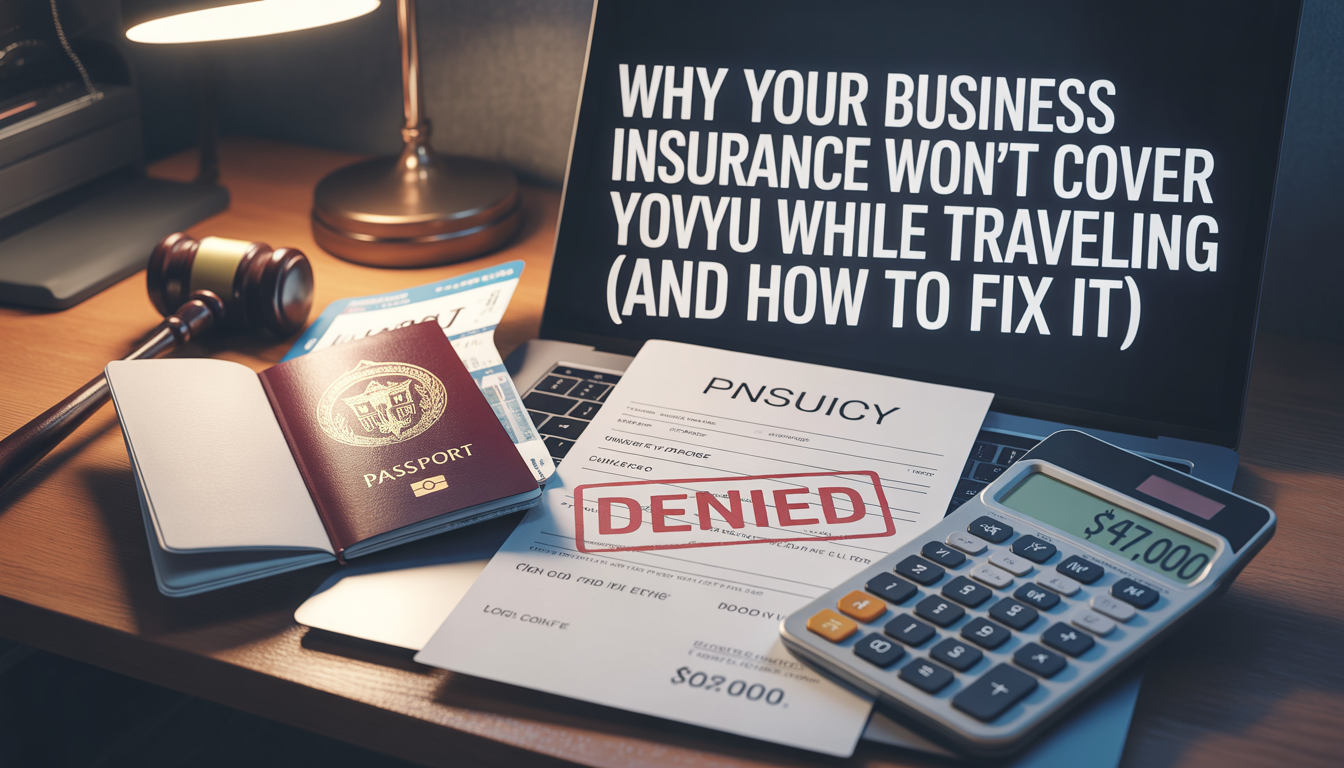
The email arrived on a Tuesday morning. I was sitting in a café in Lisbon, my laptop open, responding to client emails, feeling like I had finally achieved the perfect balance of work and travel. I was a digital nomad entrepreneur. My business was registered in Delaware. I had business insurance—general liability, professional liability, the works. I was responsible. I was protected.
Then the email came.
It was from a client in California. A project I had delivered three months earlier had caused a problem. A data migration I had overseen had resulted in a temporary system outage. The client was threatening to sue for $47,000 in alleged lost revenue.
I took a deep breath. I have professional liability insurance, I thought. This is exactly what it’s for.
I called my insurance broker. I explained the situation. I gave him my policy number. There was a long pause on the line.
“I see the policy,” he said. “But I need to ask you something. Where are you right now?”
“I’m in Lisbon,” I said.
Another pause.
“When you purchased this policy, did you tell us you would be working outside the United States?”
“No,” I said. “I didn’t think it mattered.”
“It matters,” he said. “Your policy has a territorial limitation. It only covers you for work performed within the United States. If you were outside the US when you performed any of the work related to this claim, the policy may not respond.”
My stomach dropped.
I had been traveling for eight months. I had performed virtually all of my work from cafés, coworking spaces, and Airbnb apartments across Europe and Southeast Asia. According to my insurance policy, I had been operating without coverage the entire time.
That phone call cost me $47,000. Not because I lost the lawsuit—I eventually settled for $18,000—but because I learned, in the most expensive way possible, that the business insurance I thought was protecting me was essentially worthless the moment I left my home country.
Over the next several thousand words, I am going to expose exactly why most business insurance policies stop covering you when you travel, the hidden territorial limitations, the exclusions that no one tells you about, and—most importantly—how to fix your coverage so you are actually protected no matter where in the world you work.
The Territorial Trap: What Your Policy Doesn’t Tell You
When you buy business insurance—whether it’s general liability, professional liability (errors and omissions), commercial property, or workers’ compensation—you are buying a policy that is designed for a business that operates within a specific geographic territory.
For most small business policies sold in the United States, that territory is:
- The United States of America (including its territories and possessions)
- Canada (sometimes)
- Puerto Rico (sometimes)
That’s it. The rest of the world? Not covered.
Here is how this territorial limitation is typically worded in a policy:
“This insurance applies only to ‘bodily injury,’ ‘property damage,’ ‘personal and advertising injury,’ and ‘medical expenses’ that occur within the United States of America (including its territories and possessions), Canada, or Puerto Rico.”
Or for professional liability policies:
“This policy covers claims arising from professional services performed within the United States of America.”
If you are a digital nomad, a traveling entrepreneur, or a business owner who works remotely while traveling internationally, this language is a ticking time bomb.
The Day I Lost $47,000: My Story
Let me walk you through exactly what happened, because understanding the mechanics of my claim denial will help you avoid the same trap.
The Business
I run a digital consulting firm. I help businesses with data strategy, system migrations, and process automation. My clients are primarily in the United States, though I have a few in Europe and Australia.
The Policy
I had a professional liability (errors and omissions) policy with a well-known insurance carrier. The policy had a $1,000,000 limit. I paid $2,400 per year for it. I thought I was fully protected.
The Claim
A client alleged that a data migration I managed caused a 36-hour system outage. They claimed $47,000 in lost revenue and threatened to sue. The work in question was performed over a six-week period.
The Problem
During those six weeks, I was traveling. I spent two weeks in Portugal, two weeks in Spain, and two weeks in the UK. I performed the work remotely from coworking spaces, cafés, and my Airbnb.
When I filed the claim, the insurance company conducted an investigation. They asked for my travel records. I provided my passport stamps, flight itineraries, and credit card statements.
Their response: “Because the professional services that are the subject of this claim were performed outside the United States, there is no coverage under the policy. The claim is denied.”
I hired a lawyer. We fought the denial. We argued that the work was performed for a US client, that the contract was signed in the US, that the work product was delivered to a US address. The insurance company held firm. The policy language was clear: coverage applied only to services performed within the United States.
I ended up settling with the client for $18,000 out of my own pocket. I also paid $7,000 in legal fees. Total loss: $25,000. Plus the $2,400 I had paid for a policy that was worthless the moment I left the country.
The Four Types of Business Insurance That Fail When You Travel
The territorial limitation is not the only problem. Different types of business insurance have different vulnerabilities when you travel. Here are the four most common and how they fail.
1. General Liability Insurance
What it covers: Bodily injury, property damage, and personal injury (like libel or slander) that occurs on your business premises or as a result of your business operations.
How it fails when you travel: General liability policies almost always have a territorial limitation that restricts coverage to the United States. If you are working from a coworking space in Bangkok and you accidentally spill coffee on a fellow member’s $5,000 laptop, your general liability policy likely will not cover it. If you trip and injure someone while walking to a client meeting in London, you are not covered.
The hidden risk: Many general liability policies also have “premises” limitations. They only cover you at the address listed on the policy. If you are working from a temporary location—a café, a hotel, an Airbnb—that location is not a covered premises.
2. Professional Liability (Errors & Omissions) Insurance
What it covers: Claims that your professional services caused financial harm to a client—things like negligence, missed deadlines, faulty work, or breach of contract.
How it fails when you travel: This is the trap that caught me. Most professional liability policies cover services performed within the United States only. If you perform any part of the work while physically outside the US, the policy may deny coverage entirely, even if the client is US-based.
The hidden risk: Some policies attempt to close this gap by covering “services performed anywhere in the world” but then add a “suit must be brought in the United States” requirement. If a client sues you in a foreign court, you may still have no coverage.
3. Commercial Property Insurance
What it covers: Your business equipment—laptops, cameras, tools, inventory—against theft, damage, or loss.
How it fails when you travel: Commercial property policies typically cover your equipment only at the “scheduled premises” (your office address). If you take your laptop to a coffee shop, it is covered under a “off-premises” extension—but that extension usually applies only within the United States. Take that same laptop to a café in Tokyo, and it is likely not covered.
The hidden risk: Even if your policy has a worldwide coverage extension, it often excludes certain high-risk countries. If your laptop is stolen in Brazil, Colombia, or South Africa, you may find that your policy excludes coverage for those countries entirely.
4. Workers’ Compensation Insurance
What it covers: Medical expenses and lost wages for employees who are injured on the job.
How it fails when you travel: If you have employees, and one of them travels internationally for work, your workers’ compensation policy almost certainly does not cover them outside the United States. In fact, in most states, workers’ compensation coverage is strictly territorial. An employee injured in another country has no coverage under your US policy.
The hidden risk: If you hire independent contractors or freelancers abroad, they are not covered by your workers’ compensation policy at all. But if a foreign contractor is injured while working for you, you could still face liability under local labor laws—without any insurance coverage.
The International Coverage Gap: What Happens When You’re Uninsured Abroad
When your US-based business insurance does not cover you while traveling, you are exposed in several ways:
1. Personal Liability for Business Operations
If you are sued by a client, a vendor, or a third party for something that happened while you were traveling, you will be personally responsible for your legal defense and any judgment. Your LLC or corporation may not protect you if your insurance is void.
2. No Defense Coverage
Even if you are ultimately found not liable, the cost of defending a lawsuit can be crippling. Legal fees in international disputes can easily exceed $50,000. Without insurance, you pay that out of pocket.
3. Equipment Losses
If your laptop, camera, or other business equipment is stolen, damaged, or lost while you are traveling, you will have to replace it yourself. A stolen MacBook Pro with software licenses can cost $5,000 or more to replace.
4. No Medical Coverage for Work-Related Injuries
If you are injured while working abroad—say you slip and fall in a coworking space or are injured in a taxi on the way to a client meeting—your US workers’ compensation does not cover you. Your personal health insurance may not cover you abroad. Your travel insurance may exclude “work-related” injuries.
5. No Cyber Liability Coverage
If you are working from unsecured Wi-Fi networks in hotels and cafés, your risk of a data breach or cyber attack increases dramatically. Most cyber liability policies have territorial limitations similar to general liability policies. If a breach occurs while you are traveling, you may have no coverage.
The Digital Nomad Blind Spot: Why Entrepreneurs Don’t Know About This
If you are a digital nomad or a traveling entrepreneur, you are probably reading this and thinking: I have business insurance. I’ve never heard of any of this.
You are not alone. This is a massive blind spot in the entrepreneur community. Here is why:
1. Insurance Brokers Don’t Ask
When you buy business insurance, your broker asks: “What is your business address?” They do not ask: “Do you ever work outside the United States?” Unless you volunteer that information, they will sell you a standard policy with standard territorial limitations.
2. Policy Language Is Opaque
The territorial limitation is buried in the policy. It is not in the bold “Declarations” section. It is in the “Conditions” section, often on page 15 or 20, written in dense legal language that most business owners never read.
3. The Myth of “Worldwide Coverage”
Many policies use the phrase “worldwide coverage” in their marketing materials. But if you read the fine print, “worldwide” often applies only to claims filed against you, not to the location where the work was performed. You can be sued anywhere in the world, but the work must have been done in the US.
4. Travel Insurance Confusion
Many entrepreneurs assume that travel insurance covers their business risks. It does not. Travel insurance covers personal medical emergencies, trip cancellations, and lost baggage. It does not cover professional liability, business equipment beyond minimal limits, or business interruption.
How to Fix Your Coverage: A Step-by-Step Guide
After my $47,000 lesson, I spent months researching how to properly insure a traveling business. Here is exactly what you need to do.
Step 1: Audit Your Current Policies
Before you change anything, you need to understand what you currently have. Pull out your policies and look for:
- Territorial limitation language. Look for phrases like: “This insurance applies only to acts or omissions that occur within the United States.”
- “Off-premises” coverage limits. For property coverage, look at how much coverage you have for equipment away from your business address. Is there a sub-limit? Does it apply worldwide?
- Excluded countries. Some policies list specific countries where coverage does not apply. Common exclusions include countries with US State Department travel warnings.
- “Residency” requirements. Some policies require you to maintain a primary residence in the US. If you are a full-time traveler with no permanent US address, you may be in violation of policy terms.
Step 2: Talk to Your Broker (The Right Way)
When you contact your insurance broker, do not ask: “Does my policy cover me while traveling?” The answer to that question is almost always yes, because they interpret “cover” differently than you do.
Instead, ask these specific questions:
- “If I perform professional services while physically located outside the United States, and a claim arises from those services, is there coverage under my policy?”
- “If my laptop is stolen from a café in another country, is it covered under my commercial property policy? What is the sub-limit for off-premises theft?”
- “If I am sued in a foreign court for something related to my business, does my policy provide defense coverage? Will it pay for a foreign lawyer?”
- “Does my policy exclude coverage for any specific countries? If so, which ones?”
- “What is the difference between ‘territorial limitation’ and ‘worldwide coverage’ in my policy?”
Step 3: Add a “Worldwide Territorial Extension”
For many business insurance policies, you can add a “worldwide territorial extension” or “foreign coverage endorsement.” This is an add-on that extends your coverage to include work performed outside the United States.
What it typically costs: $500–$2,000 per year, depending on your business type and revenue.
What it typically covers: Professional services performed anywhere in the world, with the exception of certain excluded countries.
What to watch for: Even with a worldwide extension, some policies still exclude coverage for claims brought in foreign courts. Look for language that says “coverage applies regardless of where the suit is brought.”
Step 4: Consider a Standalone International Professional Liability Policy
If your current carrier does not offer a worldwide extension, or if you travel extensively, consider a standalone international professional liability policy. There are several insurers that specialize in coverage for global businesses and digital nomads.
Hiscox offers professional liability policies with worldwide coverage as a standard feature. They are one of the few mainstream carriers that understand the traveling entrepreneur market.
Chubb offers international coverage for small businesses through their “Chubb Global” program. It is more expensive but provides robust worldwide protection.
AXA offers international liability coverage through their AXA Global program, which is designed for businesses with cross-border operations.
Specialty insurers like RSA, Allianz Global, and AIG offer international coverage, but they typically work through specialty brokers. You may need to find a broker who specializes in international business insurance.
Step 5: Secure Your Equipment with Inland Marine Insurance
If you travel with expensive equipment—laptops, cameras, drones, etc.—standard commercial property insurance is usually inadequate. Instead, look for an inland marine policy (sometimes called a “floater” or “equipment policy”).
Inland marine insurance is designed specifically for property that moves. It covers your equipment anywhere in the world (subject to excluded countries) and typically has higher limits for theft and damage than standard property policies.
What it costs: About 1–2% of the value of your equipment per year. For $10,000 in equipment, expect to pay $100–$200 annually.
What to look for: Make sure the policy has “worldwide” coverage, includes “mysterious disappearance” (theft without signs of forced entry), and has no unreasonable sub-limits for theft.
Step 6: Get International Health Insurance with Business Rider
If you are traveling and working, your personal health insurance may not cover you abroad. Your travel insurance may exclude work-related injuries. You need international health insurance that specifically covers business activities.
Cigna Global, Allianz Care, and GeoBlue offer international health insurance plans designed for expats and frequent travelers. Many offer “business travel” riders that cover work-related injuries and illnesses.
What it costs: $150–$500 per month depending on age, coverage level, and deductible.
What to look for: Coverage for “business activities,” no exclusion for “hazardous activities” if your work involves any physical risk, and coverage in the countries you visit.
Step 7: Consider a Foreign Voluntary Workers’ Compensation Policy
If you have employees who travel internationally, or if you hire contractors abroad, you need foreign workers’ compensation coverage. Your US workers’ comp policy does not cover international exposures.
Foreign Voluntary Workers’ Compensation (also called “foreign voluntary compensation”) is an endorsement that can be added to your US workers’ comp policy to extend coverage to international travel. It typically covers:
- Employees traveling abroad for business
- Employees temporarily assigned to foreign locations
- Third-party liability for workplace injuries in foreign countries
What it costs: Varies based on payroll and countries visited. Typically $1,000–$5,000 per year for small businesses.
Step 8: Review Your Cyber Liability Coverage
If you work remotely, your cyber risk is elevated. Unsecured Wi-Fi networks, shared workspaces, and international travel all increase your exposure to data breaches and cyber attacks.
Review your cyber liability policy for:
- Territorial limitations: Does it cover breaches that occur while you are traveling?
- “Remote work” exclusions: Some policies exclude coverage if the breach occurs while working from an unsecured network.
- International regulatory coverage: If you have clients in the EU, you may be subject to GDPR. Does your policy cover regulatory fines and penalties?
The Cost of Getting It Right: A Realistic Budget
When I was uninsured while traveling, I thought I was saving money by not paying for additional coverage. I was wrong. The $25,000 I lost on the lawsuit and legal fees would have paid for proper international coverage for more than a decade.
Here is what proper coverage costs for a traveling entrepreneur:
| Coverage | Annual Cost |
|---|---|
| Professional liability with worldwide extension | $1,500 – $3,500 |
| General liability with worldwide extension | $500 – $1,500 |
| Inland marine equipment policy | $100 – $300 |
| International health insurance | $1,800 – $6,000 |
| Cyber liability (if not included in professional liability) | $500 – $1,500 |
| Foreign voluntary workers’ comp (if applicable) | $1,000 – $5,000 |
| Total | $5,400 – $17,800 |
This sounds expensive. But compare it to the cost of a single uncovered claim. A professional liability claim can easily exceed $50,000. A stolen equipment claim can be $10,000. A medical evacuation can be $100,000.
The coverage is not an expense. It is an investment in the survival of your business.
Real Stories: Other Entrepreneurs Who Learned the Hard Way
My story is not unique. I have collected stories from other traveling entrepreneurs who faced the same rude awakening.
The Consultant Sued in Singapore
Maria, a management consultant, traveled to Singapore to work with a client for three months. While there, a dispute arose over her deliverables. The client sued her in Singaporean court for $120,000.
Maria’s US professional liability policy denied coverage because the services were performed outside the US. She had to hire a Singaporean lawyer at $800 per hour. The case dragged on for 18 months. She ultimately won, but her legal fees exceeded $45,000.
The Photographer with Stolen Gear
David, a commercial photographer, traveled to Morocco for a destination wedding shoot. While at a café, his car was broken into and $18,000 worth of camera equipment was stolen. His commercial property policy covered equipment only at his studio address. His travel insurance had a $1,000 limit for electronics. He lost $17,000.
The SaaS Founder with a Data Breach
Elena, a SaaS founder, traveled through Southeast Asia while running her company. She worked from coworking spaces and hotels, using public Wi-Fi. A hacker intercepted her connection and gained access to her company’s servers, exposing client data.
Her cyber liability policy denied coverage because the breach occurred while she was using “unsecured networks” outside the US. The policy had a “worldwide” territorial limit but an exclusion for “unsafe network environments.” She paid $35,000 in breach notification costs and regulatory fines out of pocket.
The Legal Reality: What Courts Say About Territorial Limitations
If you are thinking that you can fight a denial like I did, you should understand how courts view territorial limitations.
In general, courts enforce territorial limitations as written. Insurance policies are contracts, and courts will not rewrite them. If the policy says coverage applies only to work performed in the US, and you performed the work abroad, the denial will almost always be upheld.
There are limited exceptions:
- If the policy language is ambiguous, courts may interpret it in your favor.
- If the insurer knew you traveled and did not disclose the limitation, you may have a claim for misrepresentation.
- If the limitation is hidden in a place where no reasonable person would find it, some courts have refused to enforce it.
But these exceptions are rare. In the vast majority of cases, if you performed work outside the US and your policy has a US-only territorial limitation, you have no coverage.
How to Talk to Clients About Your Travel
If you travel while working, you also need to consider how your insurance status affects your client relationships. Many clients, especially larger corporations, require their vendors to carry specific insurance with specific territorial limits.
If you tell a client you are working from abroad, they may ask:
- Does your insurance cover work performed outside the US?
- Are you compliant with local labor and tax laws?
- How will data be protected across international borders?
If you cannot answer these questions, you may lose clients. If you answer them incorrectly and something goes wrong, you may face liability for misrepresentation.
My approach now: I am upfront with clients about my travel. I tell them that I work remotely and that my insurance includes worldwide coverage. I provide a certificate of insurance that clearly shows the territorial extension. Clients appreciate the transparency, and it protects me if a claim arises.
The Future: How the Insurance Industry Is Changing
The good news is that the insurance industry is slowly waking up to the reality of remote work and digital nomadism. Pre-2020, it was nearly impossible to find a business insurance policy with robust worldwide coverage. Now, more carriers are offering international options.
Trends to watch:
- Hiscox and Next Insurance are offering more flexible territorial limits for remote workers.
- Specialty digital nomad insurance providers like SafetyWing and World Nomads are beginning to offer business-related coverage (though limits are still low).
- Insurtech startups are building policies specifically for location-independent entrepreneurs.
But the market is still immature. For now, you cannot rely on standard policies. You must be proactive about asking for worldwide extensions and reading the fine print.
Your Action Plan: What to Do This Week
If you are a traveling entrepreneur, do not wait until you have a claim to figure out your coverage. Here is your action plan:
1. Pull Your Policies (Today)
Find your current business insurance policies. Look for the “Territory” section. If you cannot find it, call your broker and ask: “Where is the territorial limitation in my policy?”
2. Identify the Gaps (Today)
List every country you have visited for work in the past 12 months. Ask yourself: if a claim arose from work performed in any of those countries, would my policy respond? If the answer is no, you have a gap.
3. Call Your Broker (This Week)
Tell your broker: “I work remotely and travel internationally. I need my policies to have worldwide territorial coverage. What can you offer?”
If your broker does not understand the issue, find a new broker who specializes in international business insurance.
4. Get Quotes (This Week)
Request quotes for:
- Professional liability with worldwide extension
- Inland marine equipment policy
- International health insurance with business rider
5. Review Your Client Contracts (This Month)
Look at your client contracts. Do they require you to maintain insurance? Do they specify territorial limits? If your current coverage does not match your contractual obligations, you are exposed.
6. Create a Travel Insurance Policy (Ongoing)
For each trip, ensure you have personal travel insurance that covers medical emergencies, trip cancellation, and baggage loss. Do not rely on your business insurance for personal risks.
Conclusion: The $47,000 Lesson That Changed Everything
I started this article with a story about a $47,000 lawsuit and a denied claim. That experience was painful. It was expensive. It made me question whether I could continue running my business while traveling.
But it also taught me something invaluable: you cannot assume you are covered.
Business insurance is not a commodity. It is not something you buy once and forget about. It is a living document that must evolve as your business evolves. If your business evolves to include international travel, your insurance must evolve too.
I have now rebuilt my coverage. I have worldwide professional liability with a $2,000,000 limit. I have inland marine insurance for my equipment. I have international health insurance that covers me in every country I visit. I pay more for insurance than I used to—about $6,000 per year—but I sleep better.
The $47,000 claim that was denied taught me that the cost of being underinsured is far higher than the cost of being properly insured.
If you are a traveling entrepreneur, I urge you to take this seriously. Do not wait for a claim to discover that your policy is worthless. Audit your coverage today. Call your broker today. Fix the gaps today.
Your business—and your peace of mind—depend on it.